Sommaire
The new benzene OELVs in force since 2026
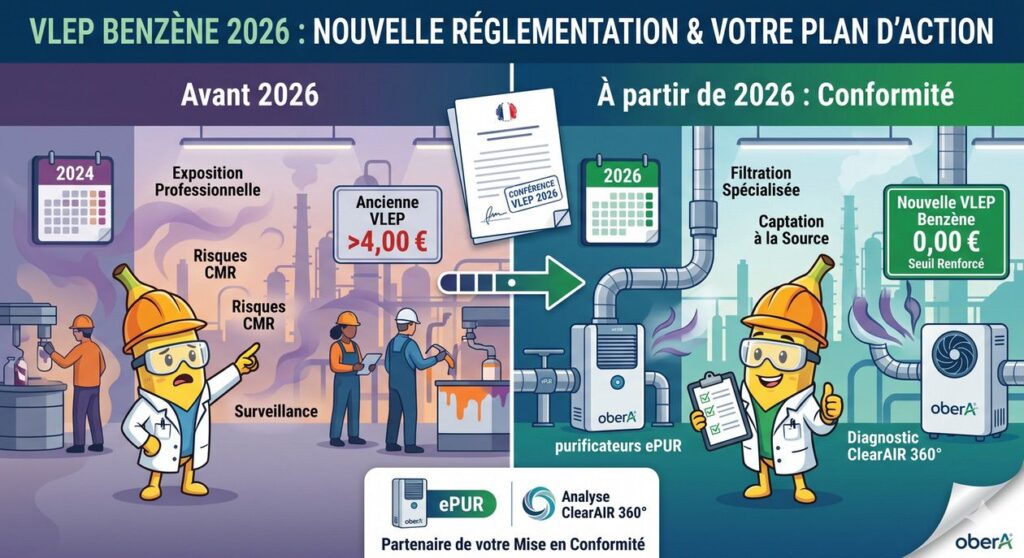
April 6, 2026 marks a major regulatory turning point for benzene in France. Since that date, the occupational exposure limit value (OELV) for benzene has been significantly tightened by Decree No. 2024-307 of April 4, 2024, which transposes Directive (EU) 2022/431. This measure directly affects all industrial sectors exposed.
Here are the reference values currently applicable:
| Period | VLEP | Equivalent in ppm |
|---|---|---|
| April 5, 2024 – April 5, 2026 | 1.65 mg/m³ | 0.5 ppm |
| From April 6, 2026 | 0.66 mg/m³ | 0.2 ppm |
The new OELV of 0.66 mg/m³ (or 0.2 ppm) represents a drastic reduction compared with the previous standards. To put this into context: it is a halving in just two years. Between 2024 and 2026, the maximum permitted exposure threshold fell from 1.65 to 0.66 mg/m³. For refineries, fine chemicals plants, and electronics production lines, this is not a simple adjustment—it is a fundamental operational change.
Benzene is classified as a Category 1A carcinogen and Category 1B mutagen under the CMR regulations (carcinogenic, mutagenic, reprotoxic). This classification reflects the serious health risks for exposed employees, justifying the increased regulatory stringency.
Legal reference: Decree No. 2024-307 of April 4, 2024, transposing Directive (EU) 2022/431 amending Directive 2004/37/EC on the protection of workers from the risks related to exposure to carcinogens or mutagens.
Why this regulatory change?
The tightening of the benzene OELV is not an isolated decision—it is part of a European harmonization of worker protection. Health authorities, including the WHO and the French National Research and Safety Institute (INRS), have accumulated scientific evidence demonstrating the carcinogenic effects of benzene at exposures well below the former thresholds.
Benzene is a volatile chemical compound that causes acute myeloid leukemia (AML) and other blood cancers in workers exposed over the long term. Even at low concentrations, repeated exposure accumulates risk in the body. Epidemiological research conducted in refineries and chemical sites has shown that workers exposed to 0.5 ppm for several years had measurable risks of leukemia. Hence the gradual reduction to 0.2 ppm.
This change also reflects a political objective: reducing occupational diseases linked to CMR agents. Benzene remains one of the most widely used CMR substances industrially in France, which justifies a particular regulatory priority.
Industrial sectors affected by the new benzene OELVs
Several business sectors are directly affected by the tightening of benzene OELVs. The main ones are:
Oil refining and petrochemicals
Refineries and petrochemical complexes concentrate the highest benzene exposures. Benzene is a major synthesis intermediate in the production of fuels, gasoline, and chemical feedstocks. Handling areas, loading/unloading, and equipment maintenance present chronic exposure risks.
Organic synthetic chemistry
The manufacture of basic chemicals—styrene, phenol, elastomers, resins, dyes—involves benzene as a reagent or solvent. Synthetic chemistry laboratories, medium- and large-scale production workshops, and packaging areas are critical points.
Paints and coatings industry
Industrial paints, automotive lacquers, adhesives, and coatings may contain residual benzene. Application, mixing, and equipment-cleaning workshops generate benzene vapors, particularly in poorly ventilated environments.
Electronics and semiconductors industry
The manufacture of electronic components uses benzene in certain cleaning and degreasing processes. Cleanrooms and microfabrication units expose technicians to residual vapors.
Automotive sector and repair
Auto garages, body shops, and fuel retail stations present benzene exposure via gasoline vapors (which may contain up to 1% benzene). Unleaded gasoline naturally contains benzene, resulting in moderate chronic exposure for pump attendants and mechanics.
Perfumery and cosmetics
Benzene is or was used as a residual solvent in formulations. Some small perfumery and cosmetics companies continue to handle raw materials containing traces of benzene.
Transport and tank sector
Tank maintenance operators, petroleum product carriers, and fuel depot attendants risk exposure during cleaning, inspection, or maintenance of tanks.
Employers’ legal obligations regarding benzene
Since April 6, 2026, failure to comply with benzene OELVs constitutes a proven offence under the French Labour Code. Employers must implement a set of strict obligations.
1. Mandatory exposure measurements
Employers must regularly measure airborne benzene exposure at workstations. These measurements must be carried out:
- Before the new OELV takes effect (no later than before April 6, 2026) to establish a compliance diagnosis
- At least once a year after that date (or more frequently if the risk requires it)
- Based on an 8-hour reference period (8h-OELV), in accordance with Articles R4412-149 et seq. of the Labour Code
Measurements must be performed by an accredited body or a recognized laboratory. The results must be retained and communicated to the occupational physician and the Social and Economic Committee (CSE).
2. Strict compliance obligation
Any measured exposure above 0.66 mg/m³ (0.2 ppm) constitutes a direct breach of the regulations. There are no exemptions or grace periods beyond April 6, 2026. Companies measuring around 0.4–0.5 ppm in 2024–2025 and believing they were “compliant” on a transitional basis must immediately review their prevention measures.
3. Enhanced medical surveillance (SMR)
All workers exposed to benzene must benefit from enhanced medical surveillance, regardless of the measured exposure level. This SMR includes:
- Clinical examinations: initial and periodic health assessments
- Biological tests: specific measurements of urinary benzene and biological exposure indicators, including S-phenylmercapturic acid (S-PMA) and trans,trans-muconic acid (t,t-MA), carried out at the end of the work shift
4. Updated single risk assessment document (DUERP)
The employer must:
- List benzene as a CMR substance in the DUERP
- Identify all positions and workers likely to be exposed
- Assess risks based on the new OELV of 0.66 mg/m³
- List the prevention measures in place (ventilation, extraction, PPE, substitution)
- Plan corrective actions if exceedances are identified
The DUERP must reflect the new regulations, not the former thresholds.
5. Action plan in the event of an exceedance
If a measurement exceeds 0.66 mg/m³, the employer must:
- Immediately inform workers, the occupational physician, the CSE, and social protection bodies
- Establish a corrective action plan prioritizing:
- Substituting the product with a less hazardous substance (if technically possible)
- Improving source capture systems (extraction, ventilation)
- Isolating the process or using closed equipment
- Reinforcing personal protective equipment (PPE)
6. Worker training and information
Employees exposed to benzene must receive mandatory training including:
- The toxicological properties of benzene
- Health risks (leukemia, blood cancers)
- Exposure routes (inhalation, skin contact)
- Prevention measures and PPE to be used
- The alert procedure in case of an issue
7. Risk of penalties
Failure to comply with benzene OELVs exposes the company to:
- A formal notice from the labour inspector with a minimum compliance period of 15 days
- Temporary shutdown of activity ordered by the labour inspectorate if the dangerous situation persists
- Fines imposed under the Labour Code (Article L. 4741-1), which may reach several thousand euros
- Criminal liability of the company and its executives in the event of a workplace accident or occupational disease linked to benzene
Technical solutions to comply with benzene OELVs 2026
Achieving and maintaining exposure below 0.66 mg/m³ requires an integrated approach to technical prevention. Here are proven solutions:
1. Source capture
Direct capture of benzene vapors at the emission point remains the most effective solution. It includes:
- Localized extraction systems: extraction hoods for mixing stations, extraction trays for tanks, ventilated cabinets for storage
- Direct vapor extraction: for petroleum product loading/unloading areas, installation of pre-connected piping with vapor recovery
- Enhanced general ventilation: for small workshops, increase fresh air flow rates and extraction to create a favorable airflow
The extraction airflow rate depends on the room configuration and the quantities handled. Typically, the target is a complete air change every 2–3 minutes in work areas.
2. Ambient air purification — Benzene filtration
When source capture cannot eliminate 100% of vapors, ambient air purification complements the system. It relies on specialized technologies:
- Activated carbon filters: granular or fibrous activated carbon very effectively adsorbs volatile organic compound (VOC) vapors and benzene. These filters are installed in air purifiers with airflow rates suited to the room volume
- ePUR purifiers with multi-stage filtration: pre-treatment filter (particles), activated carbon for VOCs/benzene, final HEPA filter to ensure compliant air quality
Filtration effectiveness depends on:
- The airflow treated by the purifier (expressed in m³/h)
- The saturation capacity of the activated carbon filter
- The filter replacement frequency (every 3–6 months depending on exposure)
3. General mechanical ventilation
For workshops, increasing general ventilation helps dilute benzene vapors:
- Air renewal: at least 10–15 air changes per hour in contaminated areas
- Directional airflow: avoid recirculation toward workstations
- Negative/positive pressure: create airflow that pushes vapors toward extraction and away from breathing zones
Ventilation alone is rarely sufficient to drop below 0.66 mg/m³ if emissions are significant—it must be combined with source extraction.
4. Substitution and source reduction
The best prevention remains eliminating or reducing benzene:
- Replace benzene-containing solvents with less toxic alternatives (alicyclic hydrocarbons, esters, bio-based solvents)
- Reduce the quantities of benzene handled, particularly in workshops, by using pre-formulated products
- Closed processes: where technically possible, transfer benzene via closed systems rather than manual handling
5. Personal protective equipment (PPE)
PPE is only effective as a last line of defense and never replaces technical measures:
- Gas masks with activated carbon cartridges for short interventions (1–2 hours)
- Impermeable protective clothing to prevent dermal absorption (benzene penetrates the skin)
- Appropriate gloves: nitrile or neoprene (resistant to benzene), changed regularly
oberA solutions for benzene 2026 compliance
oberA offers a complete range of solutions tailored to benzene regulatory requirements:
1. ePUR purifiers — Specialized VOC and benzene filtration
The ePUR purifier is sized to treat VOC vapors and benzene. Key features:
- Multi-stage filter: dust pre-treatment, then activated carbon selected for VOC/benzene adsorption
- Adjustable airflow: available in several power ratings to cover small workshops (200 m³/h) or large areas (1000+ m³/h)
- Filtration efficiency: over 95% on benzene vapors, laboratory-tested
- Simplified maintenance: filter saturation indicator, quick replacement without complex disassembly
ePUR purifiers are particularly suitable for:
- Small and medium-sized fine chemicals companies
- Paint and varnishing workshops
- Synthetic chemistry laboratories
- Automotive repair and service stations exposed to fuel
2. ClearAIR 360° service — Diagnosis and action plan
The ClearAIR 360° service is oberA’s integrated approach to benzene compliance:
- Step 1 — Exposure audit: our experts carry out a measurement campaign at the main workstations exposed to benzene. Sampling complies with current metrological standards.
- Step 2 — Results analysis: comparison with the 0.66 mg/m³ OELV, identification of critical areas, and assessment of the safety margin.
- Step 3 — Action plan: prioritized technical recommendations (extraction, purification, ventilation, substitution), costed and scheduled.
- Step 4 — Technical support: equipment selection, sizing, installation, and post-implementation follow-up.
The ClearAIR 360° service produces a complete file that can be presented to the labour inspectorate or used to justify compliance to insurers.
3. Source extraction systems
oberA designs and integrates localized extraction systems for direct capture:
- Extraction hoods sized for mixing/filling stations
- Extraction trays and downdraft tables for cleaning operations and tank handling
- Ventilated cabinets for storing products containing benzene
- Vapor recovery with airflow treatment (carbon filter or condensation)
These systems reduce exposure by 80–95%, significantly reducing the load on ambient air purification.
4. Customer feedback
oberA customers exposed to benzene (fine chemicals, secondary refining, electronics) report a 60–75% reduction in exposure after implementing combined solutions (extraction + ePUR purifier + enhanced ventilation). In 95% of cases, the new 0.66 mg/m³ thresholds are achieved and maintained.
Act now for 2026 compliance
The new benzene OELVs for 2026 represent a major change in French regulations. Companies exposed to benzene—refineries, fine chemicals, paint, electronics, automotive—must urgently review their prevention measures and equipment.
For 20 years, oberA has supported industrial companies in achieving compliance for chemical and airborne risks. Our expertise on benzene, our proven solutions (ePUR purifiers, ClearAIR 360° service), and our technical support enable companies to achieve lasting compliance with 0.66 mg/m³.
Next steps:
- Have your benzene exposure measured (if not done since 2024)
- Compare your results with the mandatory 0.66 mg/m³
- Contact oberA for a ClearAIR 360° assessment if exceedances are identified
- Size and install equipment before April 6, 2026
- Update your DUERP and communicate it to employees
Time is running out. If you have any questions about benzene 2026 compliance, contact our experts.
Legal references:
