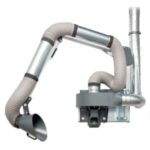
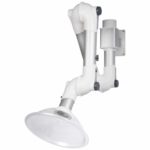
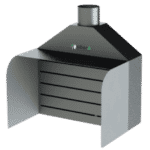
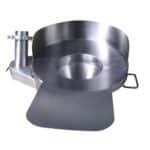
What is an industrial extractor hood?


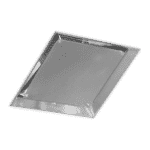
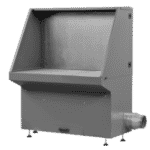
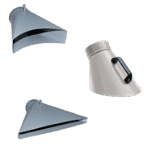
An industrial extractor hood, also known as an industrial capture hood or industrial extraction hood, is used in industry to capture and extract pollutant emissions (smoke, dust, vapors) from a manufacturing process, generally from above.
OberA modular extraction hoods are ideal for dust extraction, fume extraction and the extraction of gaseous pollutants at source. OberA industrial fume hoods capture particles and gases as close as possible to the source of emission, effectively protecting employees and limiting the spread of pollutants in the work area.
Extractor hoods need to be connected to an existing extraction network or to a nearby filtration unit or dust collector.
The wide range of available sizes, support feet, top slinging points and flexible mud flaps mean you can adapt to most suction and collection configurations. They can easily be positioned as close as possible to pollutant emissions.
Typically, extractor hoods are used above processes that generate a thermal flow (plume of fumes) due to the heat and calories released, or above a machine generating gaseous pollutants that are lighter than air and naturally rise and require extraction from above:
- Capture of emissions at the entry and exit of melting, baking, quenching and heat treatment furnaces, etc.
- Capture above a welding robot
- Capture above a bath
- Suction over a press
- Printing line suction
- Suction from casting or cooling lines
- Capping and encompassing machines that emit harmful pollutants
The advantages of modular hoods
Advantages
- For perfect source capture of fumes, solvents and dust
- Vacuuming of one or more workstations
- To be connected to a collection network or a dust collector
Special features
- Easy to design; many configurations available
- Easy to install
- Highly modular
- Mud flaps reduce the suction flow required.
Characteristics
- A wide choice of sizes and flow rates
- Highly flexible
- Easy to use and move
- Suction as close as possible to the source
When to use an industrial extractor hood?
An industrial fume hood isn’t always the best capture device, as it doesn’t always provide adequate protection for the operator, whose respiratory tract may be located between the source of pollutant emissions and the fume hood. In this case, if technically possible and sufficiently efficient, it is advisable to use a backswept suction backsplash. better suited to operator protection, but less effective in the presence of a rapid smoke plume or heat flux generating high smoke velocities.
How do you determine the flow rate to be used on an industrial extractor hood?
The suction air flow must be greater than the heat flow generated by the fumes, and the suction velocities must be greater than the upward velocities of the fumes in order to divert them into the hood.
In its guide ED2095 Principes généraux de ventilation, the INRS uses the following formula:
Suction flow Q = 1.4 PHV where P is the perimeter of the source in m, H is the height between the hood and the source, and V is the induced air velocity at the source in m/s. This induced air velocity must be greater than the ascent velocity of the fumes. Induced speeds should generally be between 0.3 and 1 m/s, depending on the process.
It’s easy to see that the further the hood is from the point of emission, the greater the flow required. This distance can be reduced and source containment improved by adding plastic strips (bibs) to the height of the hood.
We’ll be happy to help you choose the right capture system and the right intake flow rate.
Applications
Pollutants


Industries


Technical data
| Length/width (mm) | 950 | 1200 | 1450 | 1700 | 1950 |
|---|---|---|---|---|---|
| 950 | X | ||||
| 1200 | X | X | |||
| 1450 | X | X | X | ||
| 1700 | X | X | X | X | |
| 1950 | X | X | X | X | X |
| 2200 | X | X | X | X | X |
| 2450 | X | X | X | X | X |
| 2700 | X | X | X | X | X |
| 2950 | X | X | X | X | X |
| 3200 | X | X | X |
Options

OberA’s other suction and collection products