Classroom air quality can impact both student concentration and well-being at school. Sometimes the cause of headaches or eye irritation, it has been the subject of a decree, applicable from 2018 in certain establishments.
Here we take a look at the regulations and pollution control devices for a classroom.
Sommaire
Classroom air quality: regulations
It was in 2013 that the Ministries of Health and the Environment took up the problem of pollution in public spaces. They launched an action plan appended to the National Environmental Health Plan.
Establishments concerned
Articles L. 221-8 and R. 221-30 of the French Environment Code stipulate that indoor air quality monitoring must cover :
- Childcare facilities for children under 6, such as crèches and day nurseries;
- All primary and secondary schools;
- Leisure centers.
Implementation date
Decree no. 2015-1000 of August 17, 2015 thus introduces air quality monitoring in classrooms as of January :
- 2018 for all elementary school and nurseries;
- 2020 for leisure centers, middle schools and high schools.
For all other institutions open to the public, the compliance date is January 1, 2023.
Air quality in schools: monitoring
In accordance with the law, the air quality monitoring system in a classroom comprises 2 components:
- An audit of ventilation systems;
- A pollutant measurement campaign.
This includes checking that the air circulation system is accessible.
Aeration evaluation
The diagnostic section assesses how a classroom is ventilated. In particular, it assesses the condition of the classroom vents.
Note that this assessment can be carried out by the plant’s technical department.
Pollutant sampling
Samples taken on site allow precise measurement of :
- Formaldehyde ;
- Benzene ;
- Perchloroethylene ;
- CO2 ;
- Etc.
Two series of tests are then carried out approximately 6 months apart.
Measuring air pollution in the classroom
CO2 sensors are one way of accurately monitoring air quality. OberA provides all schools with devices for measuring air quality in the classroom. They are as easy to use as they are effective.
The CO2 sensor
This small box checks in real time the air quality in a classroom, or more precisely, the lack of ventilation. A CO2 sensor precisely measures and displays the concentration of carbon dioxide in ppm (“parts per million”). When the display is red, it’s time to aerate the room by opening windows or using an air purifier.
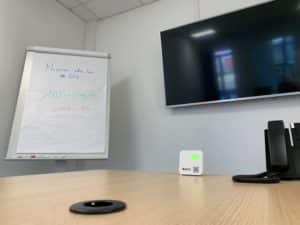
The air analyzer
Our air analyzer provides seamless monitoring of pollutants that may be present in a classroom. This discreet, connected device precisely analyzes the concentration of fine particles, VOCs, temperature, humidity and CO2 levels in a classroom. The raw data is then retrieved and displayed on a graph.
This device alerts when the 800 ppm CO2 threshold recommended by the French Ministry of Health is exceeded.
As you may have guessed, regulations now require air quality monitoring in the classroom. At OberA, we have simple monitoring devices that can warn you when carbon dioxide levels are too high. Simply aerate the room or use an air purifier to restore a healthy environment. Please do not hesitate to contact us for further information.
