In today’s production environments, automotive manufacturers need to be equipped to cope with modern heat-intensive processes, as well as the rising temperatures affecting the whole of Europe. In order to maintain productivity, ensure employee well-being and comply with strict EU regulations, evaporative cooling is an essential element of any installation.
Although traditional air conditioning can be an effective temperature control solution in relatively airtight buildings, such as offices and smaller retail spaces, there are a number of factors that make them unsuitable for large production lines and extreme working conditions.
In most cases, evaporative air cooling is not only the most cost-effective option, it’s also the only viable solution in terms of practicality and cooling efficiency.
Sommaire
Factors to consider for air cooling in automotive production
Installation costs
In large facilities such as car manufacturing plants, the initial cost of implementing an air-conditioning solution can be enormous. What’s more, installing complex systems with ducting and piping can disrupt production and hamper flexibility and future upgrades.
Efficiency
Energy consumption already accounts for a huge percentage of a vehicle manufacturing plant’s overall production costs. And while temperature control is essential, having a mechanical air-cooling system running all the time is likely to cause energy bills to skyrocket.
Practical
Particular areas of a vehicle production plant will be subject to more intense levels of heat than others; parts of some interior lamination processes, for example, take place at 120°C. This makes it a huge advantage to be able to guide fresh air exactly where it’s needed.
How does evaporative cooling compare with air conditioning?
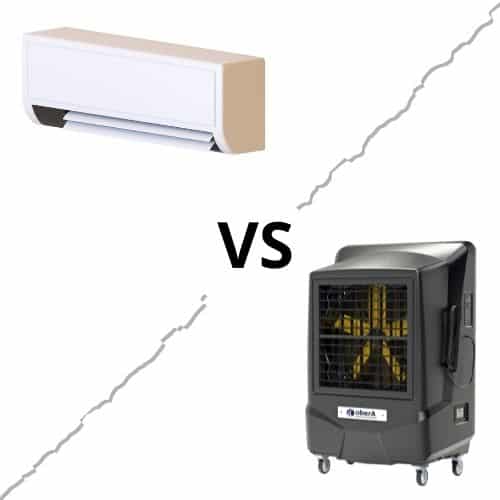
By using the natural process of evaporation to create a flow of cool air, industrial air coolers can cool hot, uncomfortable environments with exceptional energy efficiency and an ultra-simple, quick installation process.
Requiring only the suction power of a fan and the interaction of warm air and water to cool a space, evaporative air coolers are not limited by specific environmental parameters. And, unlike air conditioning, which depends on a mechanical process using refrigerant gases, evaporative air cooling is effective in well-ventilated or outdoor environments.
Powerful targeted cooling solutions also enable temperature control to be implemented where it’s needed most.
Where automotive production can benefit from evaporative air cooling
Reduce energy costs
By using outside air and exploiting latent thermal energy, evaporative air coolers are able to flow cool air into a space and reduce energy consumption by up to 90%.
Better air quality
In addition to using outside air to cool a space, evaporative cooling units are capable of filtering out dust, contaminants and other pollutants. They also help maintain comfortable humidity levels, whereas air conditioning removes moisture from the air, often rendering it stale and dry.
Improved hygiene
OberA’s evaporative cooling units not only pre-filter the air before it is recirculated into a space, but are also equipped with UV-C lights to kill viruses and bacteria.
Greater flexibility and scalability
Because the coolers are mobile on castors, they can be moved as required, as close as possible to the areas to be cooled, and can be relocated as production changes.
To find out more about the benefits of evaporative air cooling for large-scale automotive production, fill in the form below to contact our team of experts.
