Unlike air-conditioning systems, an air cooler is a simple, natural way of cooling a room. It’s based on the principle of evaporative cooling: warm air comes into contact with water, reducing ambient heat. This system is particularly well-suited to industrial environments, as it is efficient, energy-saving and far more affordable than traditional air conditioners.
If you’re wondering ” How does an air cooler work? “, this article explains how it works, its benefits and gives you tips on how to get the most out of it in an industrial environment .

Sommaire
How does an air cooler work?
Evaporative cooling principle
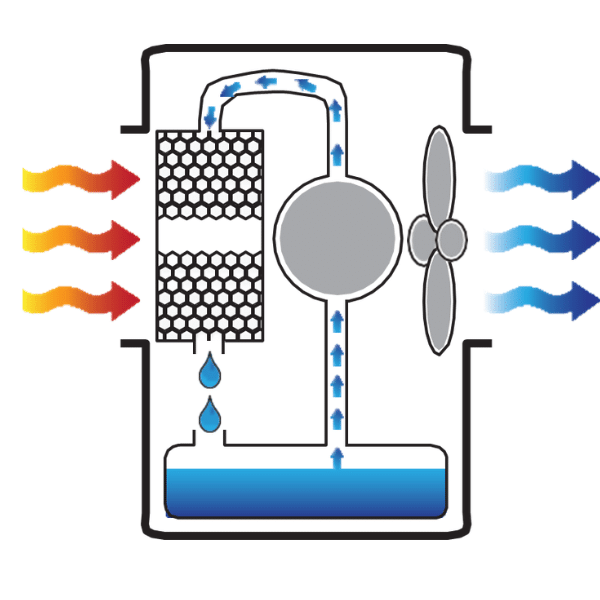
Evaporative cooling is a thermal process that lowers ambient air temperature by harnessing the energy absorbed by water as it vaporizes. When water comes into contact with warm air, some of it evaporates. This change of state requires the absorption of heat energy. This flow of heat from the ambient aircools the surrounding air. This phenomenon is referred to as adiabatic, since thermal energy is conserved in the water/air system without exchange with the outside.
The adiabatic cooler: amplifying the natural phenomenon of evaporation
Visit adiabatic coolers optimize contact between the air flow and the water flow through an evaporative medium. The evaporative medium is therefore the key component of the unit, and is designed to exploit the thermodynamic principles of evaporation to the full, generating a more intense and effective cooling effect.
Differences from air conditioning systems
Unlike a conventional air conditioner, which has a refrigerant circuit and refrigerant gas to lower the temperature, an air cooler uses water to cool the ambient air. This process is more natural and involves fewer complex components. What’s more, an air cooler doesn’t need compressors and motors, just a fan, so it consumes much less energy. This makes the unit a more economical and environmentally-friendly alternative, perfectly suited to large-scale industrial spaces.
Benefits of industrial air coolers
Energy efficiency

Industrial air coolers are far more energy-efficient than traditional air-conditioning systems. In fact, they consume on average ten times less electricity than a compressor-driven air conditioner. Electricity in adiabatic coolers is used solely to circulate water and power the fan. What’s more, their energy efficiency increases with ambient temperature, as warm air promotes water evaporation, which improves cooling performance without significantly increasing energy consumption, unlike air conditioners. This reduces energy costs over the long term and optimizes the efficiency of industrial plants, while meeting high cooling requirements.
Reduced environmental impact
Industrial air coolers have a low environmental impact. Whereas air conditioners use refrigerant gases, which can be harmful to the ozone layer and contribute to global warming, air coolers use only air and water for their operation. The absence of refrigerant gases and chemicals minimizes the ecological footprint of this equipment. What’s more, the adiabatic process generates no pollutant emissions, making it a much greener, more sustainable option for companies concerned about their environmental impact.
Easy to use, install and maintain
Compared with traditional air-conditioning systems, which require complex installation work such as ductwork, compressors and specialized wiring, air coolers can be installed quickly and without the need for costly infrastructure. What’s more, portable models are available, offering maximum flexibility. Conversely, an air conditioner often requires an air outlet installed outside the room and, even when mobile, is difficult to move easily. Service and maintenance costs for air coolers are around ten times lower than for conventional air conditioners, thanks to their simple design and limited number of components. This simplicity significantly reduces long-term operating costs, and enables businesses to benefit from an efficient cooling device without the hassle of maintaining a traditional air conditioner. Last but not least, their price is also more attractive.
Adiabatic coolers for industrial applications
Types of industries benefiting
Adiabatic units are particularly effective in a variety of industries where temperature control is essential to maintain optimum working conditions. Sectors such as food processing, manufacturing, chemicals, pharmaceuticals, textiles and printing are the biggest beneficiaries of this technology. In these environments, high thermal conditions can affect both employee productivity and product quality. These industrial coolers not only maintain a cool working environment, but also avoid the risks associated with excessive heat, such as degradation of raw materials or deterioration of heat-sensitive equipment. For example, in food production plants, maintaining a stable temperature is essential to comply with health standards and guarantee product quality. In manufacturing workshops, air coolers help to regulate the temperature of machines, prolonging their service life and optimizing production performance.
Adaptability to different working environments
Whether for enclosed spaces such as warehouses, manufacturing workshops or large-scale factories, or open spaces such as construction sites, air coolers can be easily installed to meet the specific needs of each type of environment. Their ability to adjust airflow and operate efficiently despite variations in humidity or temperature makes them a flexible solution for a variety of working environments. What’s more, they can be configured for centralized or decentralized operation, and can be fixed or mobile, depending on the size of the space to be cooled. This versatility enables companies to adopt a cooling system perfectly suited to the configuration of their site and the specifics of their activities.

Choosing an industrial air cooler
Different types of adiabatic coolers
When choosing an industrial air cooler, it’s important to understand the differences between the units. A direct cooler tends to increase the humidity in the blown air. This type is particularly effective in dry areas, where humidity can be beneficial for improving thermal comfort. An indirect cooler, on the other hand, cools the atmosphere, but without increasing the humidity of the ambient air, making it suitable for environments where hygrometry needs to be maintained at a low level, such as in the pharmaceutical or food industries. The choice of cooler must then be adjusted according to the specific sizing required to guarantee optimum efficiency in the space to be cooled.
Sizing
Sizing the air cooler is essential, and should take into account the size of the space to be cooled, the volume of air to be treated, and the cooling capacity required. It is also important to ensure that the unit’s capacity and air flow rate are adapted to guarantee cooling efficiency over the entire environment. The specific activity of the industry and the working environment must be taken into account when choosing the appropriate adiabatic device. For example, spaces with heat-generating machinery will require a higher airflow rate, while spaces more sensitive to pollution should favor models with enhanced air filtration. In addition, the type of existing building (roof, walls, window openings, etc.) will also influence the efficiency of the chosen system.
Do you need advice? We’ll help you choose the right industrial air cooler for your needs.
Tips for optimum use
How do I maintain an air cooler?
Maintenance is simple: just clean the filters, check the water tank, dust the air filter and replace the evaporative media as required.
How to maximize the efficiency of your air cooler?
To maximize the efficiency of your adiabatic air cooler, place it in a well-ventilated room and make sure there’s a constant flow of air.

How to install an air cooler
Whether fixed or mobile, the unit is easy to install. Fill the tank with water, then plug the unit into a wall socket.