In the industrial environment, many items of equipment such as furnaces, ovens and injection molding machines generate intense heat, which can affect indoor air quality, operator comfort, team productivity and even the quality of manufactured products. Faced with these challenges, the industrial air cooler or adiabatic cooler is the ideal solution for cooling large spaces.
Mobile, energy-efficient, easy to install and maintain, and available at an affordable purchase price, this unit offers many advantages for efficient cooling of workshops, warehouses, factories or large industrial areas. But do you really know all its advantages?
Sommaire
How an industrial air cooler works
How does an air cooler work in the workplace?
An air cooler works on the principle of evaporative cooling. Specifically, the system draws in warm, dry air using a fan. The air then passes through a medium soaked in water from the unit’s reservoir, enabling it to be humidified. When the hot air comes into contact with this moist media, some of the water evaporates. Water evaporation requires energy to break the hydrogen bonds between water molecules. This energy is extracted from the hot air, reducing its temperature. The higher the ambient temperature, the greater the heat reduction achieved, as warm air encourages evaporation, thus improving the cooler’s energy efficiency. Unlike air-conditioning systems, adiabatic coolers offer an economical, high-performance solution for cooling air, particularly in hot, dry environments. It is particularly well suited to large, open, well-ventilated spaces, as well as to industries where heat production is high.
Air cooler, air conditioner, industrial fan… what’s the difference?
The fan simply stirs the ambient air without changing its temperature. Its purely mechanical action creates a flow of air that enhances the sensation of freshness by accelerating the evaporation of perspiration from the skin. It has no effect on heat or humidity in the room, which limits its effectiveness in industrial environments where heat is intense and air stagnant.
Industrial air conditioners, on the other hand, require the use of refrigerants, which can have environmental impacts, and result in high energy consumption, particularly when outside temperatures rise. What’s more, air conditioners dry out the air and can cause a “cold snap” effect. Although an air-conditioning system is capable of maintaining a precise temperature, it is not suitable for large industrial premises due to its high energy intensity.
In contrast, the air cooler stands out for its simple, economical operation. Based on the principle of adiabatic cooling by evaporation of water, it uses neither compressors nor chemical refrigerants, which considerably reduces energy consumption. Particularly effective in hot, dry environments, whereevaporation is optimized, the cooler offers high energy efficiency, making it an ideal solution for cooling large industrial spaces and open areas.
The main benefits of air coolers for professionals

Reduced energy consumption and operating costs
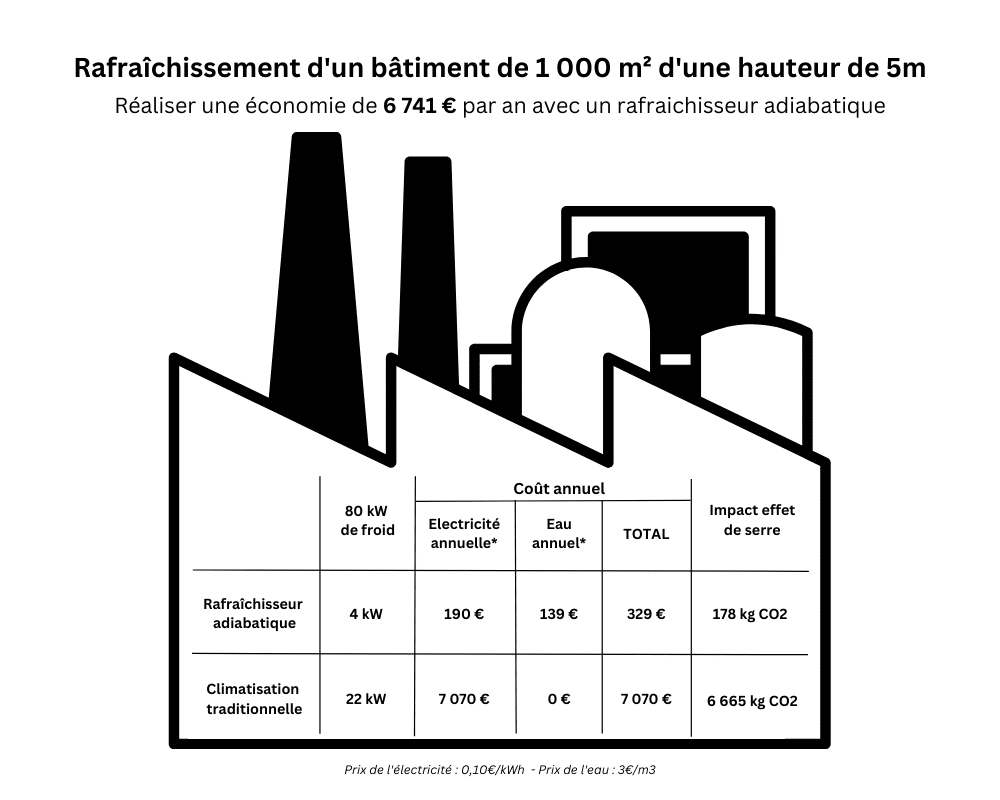
The air cooler is limited to the electrical consumption required to operate the air and water circulation, which significantly reduces the electricity bill compared to an air conditioner. Since it requires no refrigerant, its energy-efficient operation minimizes its environmental impact, making it a greener, more environmentally-friendly alternative.
Maintenance is also simplified, as the adiabatic cooler does not require the intervention of a certified professional as is the case with an air conditioner. What’s more, the daily running cost of an air cooler is very low, often just a few tens of cents for a 250 m² room, well below that of an air conditioner.Installation is also less expensive, and maintenance is limited to periodic cleaning of the tank and filter, and annual servicing of the other components. This considerably reduces maintenance costs, which are around 10 times lower than those of traditional air conditioners.
In short, the adiabatic air cooler offers low energy consumption, negligible daily operating costs and low installation and maintenance costs. It’s an environmentally-friendly, low-energy alternative with a minimal carbon footprint and an affordable purchase price.
Improved working conditions and productivity
By lowering the temperature and increasing the relative humidity on the shop floor, industrial coolers help combat heat stress, a phenomenon that occurs when temperatures rise above 24-26°C, and whose effects are even more pronounced above 33-34°C, with a drop in productivity of up to 50%. By diffusing cooled, humid air into the room, fresheners offer greater thermal comfort and reduce the feeling of discomfort.
What’s more, the coolers are equipped with a filter to trap dust and pollutants, ensuring clean, hygienic air in the room. Their low noise level, 10 dB lower than that of air conditioners, contributes to a more pleasant working environment that complies with regulatory standards for working conditions. This enhanced comfort translates into less downtime and higher employee productivity.
Versatility: use in workshops, warehouses or offices
An air cooler is versatile , so it can be used in a variety of spaces such as industrial workshops, warehouses, offices, or even commercial spaces. It’s perfectly suited to a variety of space configurations, whether for open areas and rooms with specific layouts, or environments where heat is intense. With a variety of models (double-stage, direct, reversible cooling, etc.), mobile or fixed, the air cooler offers a made-to-measure cooling solution .
Limits to be considered in industrial environments
Adaptation to climatic conditions
Air coolers are particularly effective in hot, dry environments. On the other hand, their performance can be reduced in conditions of high humidity, as the water-saturated air limits the evaporation needed for cooling. As a result, these units are not suitable for environments with high humidity.
What’s more, air coolers don’t offer precise temperature control. Although they can lower the air temperature by 5 to 11°C, depending on the size of the installation and outdoor conditions, they cannot maintain a constant temperature in an enclosed space. Unlike air conditioners, which offer stable, precise control, however, air coolers have the advantage of being more affordable, especially for large volumes and open spaces, where installing an air conditioner may be technically or economically impossible.
Maintenance and durability of heavy-duty equipment
In an industrial environment, maintenance of air coolers is relatively simple and inexpensive compared to that of air conditioners. When used intensively, however, regular maintenance is necessary to ensure their smooth operation, in particular by checking that evaporation systems are working properly. Filters should be cleaned periodically, and water tanks checked to prevent the formation of mould or deposits. Theabsence of compressors and refrigerants makes these units less susceptible to complex breakdowns. Nevertheless, inadequate maintenance could reduce their service life and performance.
How to choose an evaporative air cooler for professional use?

Volume of air to be treated and power required
The choice of an air cooler depends above all on the specific cooling requirements of your working environment and the surface area of your workshop or production space. In fact, the higher the ambient temperature and the larger the surface area to be treated, the higher the air flow rate and power of the cooler must be to be effective.
Obera offers air cooler models to suit different needs, with units able to handle spaces ranging from 80 to 400 m², depending on the power selected. It is also possible to combine several units to cover even larger spaces, offering a flexible, scalable option as cooling requirements evolve.
Mobility and compatibility with industrial areas
Another criterion to consider is the cooler’s mobility, especially if localized cooling is required in certain work areas. Mobile models, equipped with castors, make it easy to move the unit around the room, responding quickly to urgent or one-off cooling requirements. This flexibility is a major asset in atypical workspaces or production areas where installing an air conditioner would be too complex or impractical.
To illustrate theeffectiveness of an adiabatic air cooler in a complex environment, let’s take the example of cooling a shipping container. The mobile system we installed (models from the Ecoclim range) helped reduce the container’s internal temperature, which was reaching extreme levels, close to 50°C. Thanks to the evaporation of water, the unit’s integrated fan effectively cooled the air to 32°C. This strategy improved productivity while preserving operator safety.
Compliance with environmental and energy standards
Air coolers meet current environmental and energy standards for air conditioning. They help reduce greenhouse gas emissions, in line with European directives. Their low energy consumption makes them compatible with the requirements of the ISO 50001 standard on energy management and the EcoDesign regulation. What’s more, by being designed to optimize energy efficiency, they fit perfectly into environmental management systems. This makes them a sustainable and environmentally-friendly industrial cooling solution.
