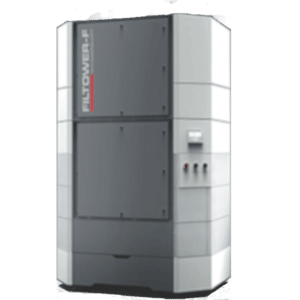
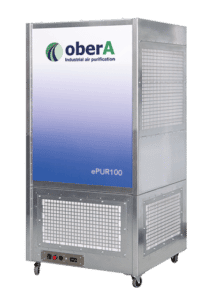
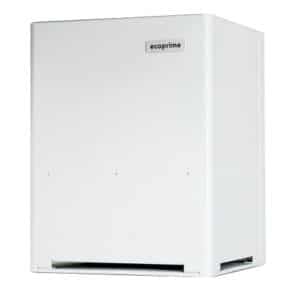
Our ePUR CA professional air purifiers are mobile activated carbon air treatment units, requiring no piping or assembly.
Sommaire
- How do our professional air purifiers work?
- Which pollutants can be treated with ePUR CA activated carbon air purifiers?
- What are they designed for?
- What are the features of our professional air purifiers?
- What are the advantages of this range of ePUR CA professional air purifiers?
- Examples of applications for our activated carbon air purifiers:
- How to configure your professional activated charcoal air purifier?
- Other air purifiers from the brand oberA
How do our professional air purifiers work?
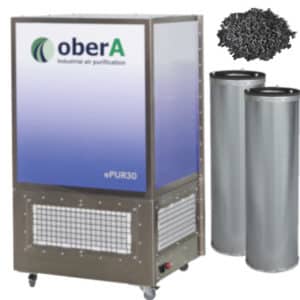
Operation is simple: polluted air is drawn in through the top of the unit. Subsequently, solid and liquid particles are stopped by successive layers of filters, and any gaseous pollutants by the activated carbon filter.
The air purifier purifies the air in a workspace by forcing it through the various filtration stages. The air purifier draws in a column of slightly warmer air from above and discharges it back into the workspace at floor level. This lighter air rises naturally in the room, creating a circular movement that treats all the air in the volume. With each pass through the air purifier, between 80% and 99.995% (depending on the filter configuration chosen) of pollution is captured,improving air quality throughout the workspace.
All air purifiers in the range are equipped with a potentiometer, enabling air flow to be adjusted from 0 to 100%. The air flow rate is adjusted according to the initial pollutant concentration, the desired result and the volume of the area to be treated. Depending on these parameters, a number of zone volume changes per hour is selected.
Which pollutants can be treated with ePUR CA activated carbon air purifiers?
ePUR CA air purifiers are ideal for treating odors, VOCs (Volatile Organic Compounds) and other gaseous pollutants. More specifically, they enable :
- Capture and treatment of odors and olfactory pollution.
- Processes using solvents (paint, varnish, cleaning, degreasing, aerosols, etc.). These are volatile organic compounds made from aliphatic hydrocarbons (hexane, cyclohexane, …), chlorinated hydrocarbons (trichloroethylene, trichloroethane, monochlorobenzene … ), aromatics (toluene, xylene …), alcohols (methanol, glycols … ), ketones (acetone, ethyl acetate, methyl ethyl ketone MEK or butanone …), glycol ethers, tetrahydrofuran THF, etc…..
- Gluing pollutants (odors and gaseous pollutants from neoprene glues or – Hardeners and setting gas pedals. The hardeners used are aliphatic or aromatic amines and polyisocyanates.
- Gaseous pollutants from resins (cyanoacrylic polymers, vinyls, epoxies, polyurethanes, polyesters, polychloroprenes, polyamides, formo-phenolics, furanics, polysilanes, polysiloxanes, formaldehyde, etc.) are a major source of pollution.
Thanks to the very large specific surface area of its cavities, activated carbon is capable of trapping many types of gaseous pollutants.

What are they designed for?
Our ePUR CA air purifiers are often used in conjunction with source capture systems to extract and filter remaining gaseous pollutants directly into the atmosphere. These units can also be used for source extraction, by fitting them with a suction arm or extraction hood, or by connecting them directly to a production machine or suction table.
Recommended use is purely professional.
These activated carbon air purifiers are ideal for use in the metal, plastics, chemical, food, textile, wood, paper and cardboard, minerals, waste collection and recycling and art restoration industries.
See below for some examples of applications for our ePUR CA professional air purifiers.
Pollutants


Industries


What type of coal should I choose for my application?
ePUR CA air purifiers can be fitted with a wide range ofadsorbents.
OBERA uses a high-efficiency generic activated carbon OBCKV. Nevertheless, it is possible to select thermally or chemically activated activated carbons, as well as oxidized or chemically impregnated activated carbons.
These “doped” activated carbons increase treatment efficiency.


What are the features of our professional air purifiers?
Powerful and quiet, ePUR CA air purifiers are designed for ease of use. So, with no assembly and no extraction duct, just a simple plug-in to an electrical socket and you’re ready to go. Mounted on castors, you can move the units for maximum ease of use.
They consume less energy (less than a domestic vacuum cleaner) and the filter media can be changed in 5 minutes with a single hexagonal wrench, making maintenance quick and easy. Activated carbon cartridges are selected according to your specific needs and the pollutants to be treated. Flow rates vary depending on the unit: the smallest in the range, the ePUR CA 10, has a flow rate of 1000m3/h. For the mid-range ePUR CA 30, the flow rate is 3500 m3/h. Finally, the most powerful unit, the ePUR CA 100, available on request only, has a flow rate of 10,000 m3/h.
| Device | ePUR 10 | ePUR 30 | ePUR 100 | |
|---|---|---|---|---|
| Flow | m3/h | 1 000 | 3 500 | 10 000 |
| Intensity | A | 0.7 | 1.1 | 3.3 |
| Supply voltage | V | 230 | 230 | 230 |
| Power | kW | 0.08 | 0.25 | 0,75 |
| Dimensions | l/L/h (cm) | 66 x 37 x 78 | 66 x 68 x 125 | 90 x 90 x 182 |
| Charge of activated carbon | kg | 7.5 | 26 | On request |
| Sound level | dB(A) | 63 | 65 | 69 |
What are the advantages of this range of ePUR CA professional air purifiers?
In addition toimproving air quality, our professional air purifiers protect employees from fine particles and other gaseous pollutants, to minimize exposure to lung and heart disease.
The savings in energy and cleaning costs are also significant, thanks to the air flow created by the machine, which brings hot air from above downwards, thus tempering the workspace. The heat from the filtered air is also reintroduced into the building, reducing heating consumption.
Another advantage is that protecting production tools leads to a reduction in breakdowns, and therefore helps to increase the longevity of production machines. More to the point, our industrial air purifiers also comply with Occupational Exposure Limit Values(OELVs).
Advantages
- Plug & Play: just plug it in and it’s done!
- Powerful and quiet
- No installation or extraction ducts
- Designed for easy mobility on castors
- Very low power consumption (less than a household vacuum cleaner)
Special features
- Cartridges loaded with activated carbon selected according to the pollutants to be treated.
- Reusable and recyclable cartridges
- Change filter media yourself in just 5 minutes, using just one Allen key
- Plugs into a standard 220V socket
Characteristics
- Significantly improves air quality in production workshops, complementing existing systems
- Captures pollutants where source capture is not possible
Examples of applications for our activated carbon air purifiers:
hair salons, nail salons and beauty salons

Hair salons, nail salons and beauty salons are particularly exposed to air quality risks, and their activities generate pollutants in the form of aerosols, fine dust and numerous gaseous pollutants from products such as ammonia, perming products, hair bleaching and coloring products, sprays, hydrogen peroxide, formaldehydes and hair.
Hairdressers and beauticians are often confronted with strong odors, irritation, headaches or respiratory allergies. Hair salons, nail salons and beauty salons are generally poorly ventilated. Air purifiers are a solution for improving overall air quality. They can be used either with an arm for source capture and/or directly in the environment.
Recommended filter configuration: G4 + E11 + Activated carbon (with capture arm)
Open spaces/offices

Staff working in offices or open-plan offices are particularly exposed to air pollution from outside (dust, odours, pollen and pollution in urban areas), indoor pollution (biological: viruses, bacteria, microbes) and chemical pollution (odours, cleaning products and pollutants released by furniture, paint, carpets and other building materials).
This phenomenon is exacerbated if the offices are ventilated, depressed, and adjacent to a production workshop or polluted urban area. In this case, air pollution is transmitted to the offices.
Recommended filter configuration: G4 + F8 or G4 + H14 or G4 + H14 + activated carbon
Medical sector (hospitals, nursing homes, veterinary surgeons, chiropodists, dentists and dental technicians, medical practices, funeral homes)

The needs are diverse:
- Improve air quality to reduce airborne contamination (viruses, bacteria).
- Disinfect and prevent the spread of viruses, bacteria, etc.
- Eliminate annoying odors and neutralize various types of olfactory pollution.
- Reduce dust levels in dust-generating activities.
Establishments open to the public (communities, nurseries, schools)
Indoor air quality monitoring has been mandatory in educational establishments since January1, 2020, and in day-care centers since January1, 2018.
Air quality parameters include fine particles, formaldehyde, VOCs, benzene and carbon dioxide. Symptoms of poor air quality include headaches, irritation and respiratory allergies.
The phenomenon is aggravated if spaces are poorly ventilated or not aired. A room air purifier can be installed to treat these different sources of pollution.
How to configure your professional activated charcoal air purifier?
It’s important to know that gaseous (molecular) pollutants are stopped on an adsorbent such as activated carbon. Particulate pollutants (dust, smoke, fog, etc.) are stopped by a particulate filter.
ePUR CA air purifiers can contain 2 to 3 configurable filtration stages.
If the pollution is particulate, the 4 filtration stages are dedicated to the successive separation of the different particle sizes. All filtration classes can be used, from ISO Coarse 50% (formerly G3) to HEPA H14.
If the pollutants are gaseous, two stages of activated carbon and a first stage of particulate filter are required to protect the activated carbon.
Where gaseous and particulate pollutants are combined, particulate filter stages are combined with one or more activated carbon filter stages. Particulate filters are used to protect the activated carbon filter, guaranteeing its longevity and efficiency.
When dealing with viruses, bacteria, CMR or hazardous dusts, select high-efficiency filters (EPE E11 and higher).
In the presence of high dust concentrations, it is important to multiply the number of pre-filtration stages in order to protect the highest-quality filter. Note that an H14 filter can be worth up to 4 times the price of an F8 filter.
You should also be aware that a high-efficiency filter is not necessarily necessary if the dust to be treated is coarse. In fact, the latter is likely to clog up much more quickly than a filter suitable for coarse dust, and will therefore be more expensive to replace.
Here are some examples of possible air filter configurations:
- G4/F8 for dust classes L
- G4/E11 for dust classes M to H
- G4 /F8 / HEPA H14 for dust classes H
- G3/F8/H14 for dust classes H
- G4 / F8 / E11 for dust classes M to H
- G3 / F8 / E11 for dust classes M to H
- G4 / F8/ Activated carbon for dust class L and odour treatment
- G3 / F8/ Activated carbon for dust class L and odour treatment
- F7/ H14 / activated carbon for dust class H and odour treatment
- F7/E11/ activated carbon for dust classes M to H and odor treatment.
- G4 / CA/ CA Only for odor treatment.
The majority of our filters up to EPA E11 are 100% polyester, containing no dyes, solvents or binders, so we don’t use glass fibers that release carcinogenic fibers.
Other air purifiers from the brand oberA