In the wood industry, climatic conditions play a decisive role at every stage of production. To guarantee consistent quality, preserve materials and ensure safe working environments, ambient air control is becoming a real performance driver.
As a specialist in industrial air treatment, OberA offers adiabatic cooling solutions perfectly adapted to the specific constraints of the wood sector. Thanks to a natural, economical and efficient technology, our systems enable temperature and humidity control, while meeting the economic, technical and environmental challenges faced by wood industry professionals.

Sommaire
Why choose an air cooler in the wood industry?
In the woodworking industry, theuse of air coolers (or air cooling systems, such as evaporative coolers) is essential for a number of technical, human and economic reasons. Here’s a detailed explanation, including the impact ofrising temperatures in this specific sector:
1. Preserving the raw material (wood)
In the wood industry, ambient temperature and humidity play a crucial role in material stability. As wood is hygroscopic, it reacts strongly to temperature variations, in particular through excessive moisture loss when it’s too hot. This can lead to defects such as cracks, deformation or irregular shrinkage, compromising the quality of finished products. Maintaining a controlled climate with air coolers therefore helps preserve the integrity and dimensional stability of wood throughout the transformation process.
2. Worker comfort and safety
Wood-processing workshops are often exposed to heat, noise and dust, making for challenging working conditions. In hot weather, operators can suffer from fatigue, loss of concentration and even heat stress, increasing the risk of accidents. Theuse of air coolers makes it possible to maintain a more bearable ambient temperature, without drying out the air, unlike traditional air conditioning. This promotes staff well-being and improves workplace safety.
3. Reduced accumulation of flammable dust
Wood dust is highly flammable and a real hazard in industrial environments. By improving air circulation, air fresheners better direct fine particles towards extraction and ventilation systems, reducing their concentration in the ambient air. This helps prevent the risk of explosion or fire, while ensuring a more hygienic working environment .
4. Machine efficiency and energy savings
Excessive heat can also affect the performance of machine tools, accelerating heating and wear. Moderate temperatures keep equipment running optimally, limiting downtime for maintenance and extending its service life. At the same time, air coolers consume less energy than conventional air-conditioning systems, making it possible to reconcile technical efficiency with energy savings – an important asset in such an energy-intensive sector.
5. Environmental considerations
Last but not least, air fresheners offer a significant ecological advantage. Operating by evaporation, they require neither refrigerant gases nor high energy consumption, unlike conventional air conditioners. This environmentally-friendly cooling method is particularly well-suited to the large-scale, open-plan workshops typical of the woodworking industry, which demand high-performance, economical and sustainable solutions.
How adiabatic coolers work
A natural principle for controlled temperature
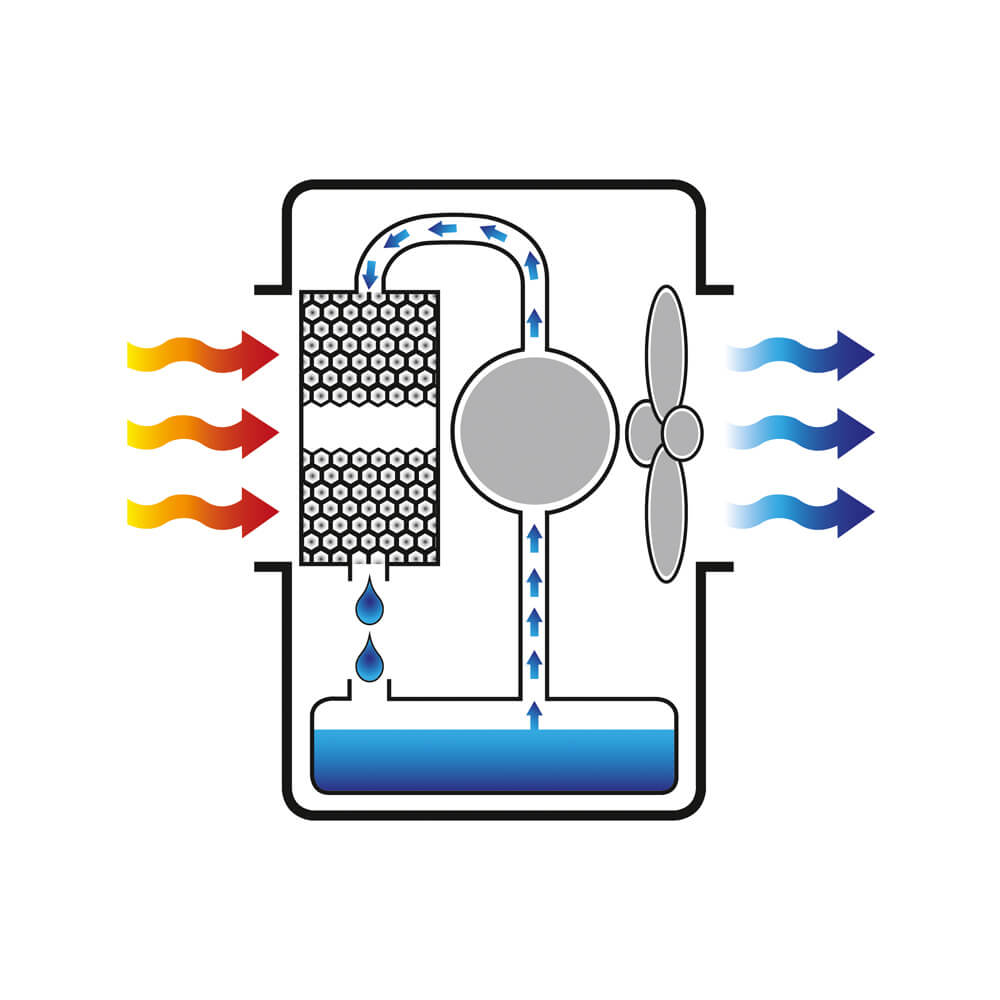
The operation of an adiabatic cooler is based on a simple, natural physical process: warm ambient air is drawn in and then passed through a humid medium, usually a water-soaked honeycomb structure. As it passes through this medium, the air gives up some of its heat to the water by evaporation, resulting in an immediate drop in the temperature of the blown air.
Unlike traditional air conditioning, this system uses neither refrigerant gas nor compressors, considerably reducing the system’s energy footprint.
Advantages for woodworking shops
- Effective cooling even in large open or semi-open spaces;
- Maintains a stable humidity level, preventing wood from warping or shrinking;
- Improved thermal comfort for operators without drying out the air;
- Reduce heat-related risks (accidents, fatigue, loss of concentration);
- Better dispersion of fine dust, limiting accumulation;
- Low energy consumption, simple installation and low maintenance.
The OberA word: our systems are designed to adapt to specific specific requirements of each site: air flow, building volume, type of activity and wood species handled. OberA supports wood professionals in their efforts to achieve efficient, sustainable thermal management.
Our tips for choosing a cooler that meets the demands of the woodworking industry
- Assess the volume to be treated: choose a machine suited to the size and height of the building, especially in open-plan workshops.
- Analyze the need for air renewal: opt for sufficient airflow to evacuate heat and dust efficiently.
- Favoring a good hygrometric balance: choose an adiabatic cooler that maintains stable humidity, which is good for wood.
- Check water and energy consumption: choose an energy-efficient model, especially if the appliance is to run continuously.
- Keep maintenance in mind: select a system that’s easy to clean, with filters and media easily accessible.
- Check the noise level: choose a quiet model if sensitive workstations or precision work are involved.
- Rely on an air-handling expert : call on a specialized service provider for customized sizing and installation.
IC range: air coolers for the wood industry
Designed to meet the demands of demanding industrial environments, the IC OberA range of air coolers offers a robust, economical solution perfectly suited to woodworking workshops.
Designed to operate in open or semi-open environments, IC models provide efficient evaporative cooling, while guaranteeing optimum humidity levels to preserve the wood. Their reinforced structure, high air flow rate and low energy consumption make them a strategic choice for professionals seeking to combine production quality, working comfort and cost control.
The advantages of the IC range :
- Powerful air flows up to 30,000 m³/h ;
- Natural adiabatic cooling without refrigerant ;
- Dust- and moisture-resistant materials ;
- Simple roof, façade or mobile installation, depending on site constraints;
- Low maintenance thanks to easy access to media and internal components ;
- Manual or automatic control depending on control requirements ;
- Design equipment that integrates easily into your workshops.
With the IC range, OberA offers a concrete response to the thermal problems specific to the wood industry. Our experts accompany you from technical study to installation, for a tailor-made, durable and scalable solution.
