How many devices increase the heat in your industrial premises and reduce their thermal comfort? So, when the temperature rises in hot weather, heating the buildings will threaten safety, operator health and product quality…
How do you lower the temperature without compromising your company’s sustainable development principles?
Adiabatic cooling is the natural, economical alternative to traditional air-conditioning techniques. How does an adiabatic cooler work? What are the advantages over conventional air-conditioning solutions? How to optimize an air cooling system? We’ll give you the solution!
Sommaire
How does an adiabatic cooler work?
The evaporation of water consumes heat from the air, lowering its temperature. The application of this natural principle drives the operation of industrial air coolers.
The adiabatic air-conditioning system optimizes air cooling by evaporating water. Evaporative coolers are a natural type of air conditioner for reducing room temperature.
Air-conditioning technology in industrial chillers transfers heat from the air to the cooling water, stimulating evaporation. The humidity control principle is based on ventilated building operation combined with adiabatic cooler blowing.
A water evaporation cooling system
Evaporation is the transformation of water into gas, accompanied by the consumption of heat. This energy consumption generates the cooling gas (humidity). Air-conditioning systems with adiabatic chillers represent the technical application of this energy principle.
Adiabatic refers to the principle of energy conservation in the cooler’s air/water system. Energy circulates between air and water through: heat extracted from air, heating of cooling water, energy from evaporation of water into cooling gas.
How to choose and use an industrial air cooler?
How an adiabatic cooling unit works
The air cooler’s evaporative heat exchanger: – crosses air flow and cooling water flow; – produces evaporation and cooling. The ventilation module regulates the air flow through the adiabatic exchanger and the humidity. A module, comprising pump and reservoir, distributes the water to the evaporative cooler.
Evaporative heat exchanger technology increases energy transfer through air-water contact, accelerating the evaporation of water into cooling gas. The flow of air supplies its heat to the flow of cooling water, resulting in evaporation that provides cooling and humidity.
The ventilation module of adiabatic coolers blows cooling air, pushing indoor air out of the room through the ventilation system. Result on the premises? Low temperature, comfortable humidity.
Temperature and humidity control
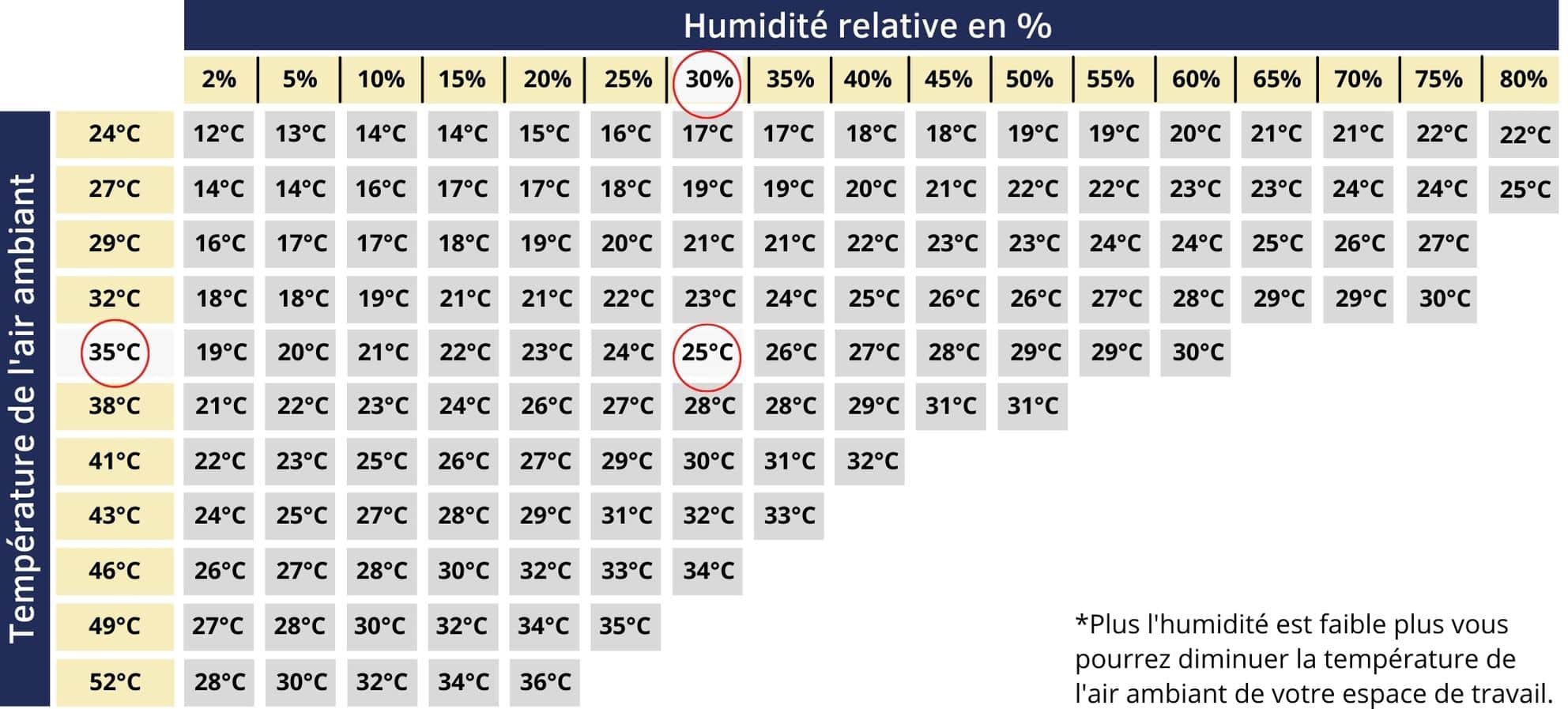
Evaporative cooling reduces air temperature by 10 to 20°C and increases relative humidity by 5 to 10%. Warm, dry air enhances the cooling efficiency of the air cooler.
Adiabatic coolers are efficient air-conditioning systems for the following applications:
- cooling an entire industrial building (high-volume premises)
- create a local cool island to counteract air heating around appliances (oven, proofer, etc.).
What are the advantages of adiabatic cooling?
The adiabatic cooler provides economical, natural, healthy and practical air conditioning.
Air-conditioning technology with minimal energy consumption
An adiabatic cooling air-conditioning system uses the thermal energy of the air in evaporation for cooling. The energy used to blow air and circulate water determines the energy consumption of an air cooler. Traditional air-conditioning systems consume a lot of energy! Compared with an air conditioner, lowering the temperature by adiabatic cooling reduces your electricity consumption by 80-90%.

An environmentally-friendly cooling system
To cool the air, an adiabatic cooler uses water: a harmless refrigerant that protects health and the environment. (Unlike traditional air-conditioning solutions!) The water consumption of industrial chillers is reduced to evaporation. In operation, the adiabatic cooler cannot pollute water or air (air-conditioning systems can!). Conclusion: the adiabatic air-conditioning solution for industrial premises is environmentally friendly.

Improved indoor air quality
An adiabatic cooler simultaneously improves industrial workspace temperature and indoor air quality! The filtration system removes dust from the air. With their UV sterilizer, our adiabatic cooling systems eliminate viruses and bacteria.
The adiabatic cooler: distributes purified, humidified and cooled air; lowers warehouse temperature. At the same time, the indoor air leaves the building via the ventilation system. Adiabatic air-conditioning constantly renews the air. In this way, chillers guarantee the safety, health and comfort of employees.

Attention to health, safety and operating comfort
At 66 decibels, the noise of our coolers causes no hearing fatigue. (Noise level of a vacuum cleaner: 76 dB)Daily refilling of the cooler tank, or automatic refilling for greater comfort, ensures safe water consumption. A level valve prevents any risk of overflow.

Quick and easy installation
Installation of the air-conditioning system is as simple as filling the water tank and connecting the mobile adiabatic cooler (Ecoclim range).
Cooling becomes a priority elsewhere? On wheels, these adiabatic coolers can be quickly reinstalled in other premises. These industrial chillers can be installed as temporary or permanent cooling solutions.
Roof-mounted coolers with a plenum are easier to install than traditional air conditioners with a cooling network.
How can I optimize the operation of my adiabatic cooler?
A natural air-conditioning system, an adiabatic cooler is optimized according to several parameters: volume to be cooled, workshop ventilation, external temperature and humidity, heat from equipment, air renewal and desired temperature.
Ensure good building ventilation
Ventilation and air renewal enhance the air cooler’s energy efficiency. An air cooling system induces humidity. Maintaining a comfortable humidity level and diffusing a pleasant air flow are achieved by combining the adiabatic air cooler’s supply air and building ventilation.
Choose an airflow rate suited to the surface area of the room
Temperature, humidity and the volume of air to be treated to cool the workspace determine the air delivery capacity of the coolers, depending on the surface area of the room.
Our IC range includes adiabatic coolers of increasing power, with flow, temperature and humidity control systems…
