This refers to the process of cleaning and removing flammable or explosive dust present in various industrial environments. Explosive dusts are fine molecules that can accumulate in the air or on surfaces and present a serious threat of explosion or fire if they come into contact with a source of ignition, such as a spark or open flame.
Explosive dust hazards are significant in many industrial sectors, including food production, aerospace (aluminum, titanium, composites), chemicals, wood, pharmaceuticals, mining and power generation. When they accumulate in sufficiently high concentrations and are dispersed in the air, they can form an explosive mixture.
Sommaire
- The main risks associated with explosive dusts are as follows:
- Regulations and standards governing the removal of explosive dust
- Minimize the risks associated with explosive dusts
- The different classifications of explosive dusts
- Flammable dust characteristics
- Combustible dust characteristics
- Update on pyrophoric dust :
- Explosive dust fire and explosion scenarios
The main risks associated with explosive dusts are as follows:
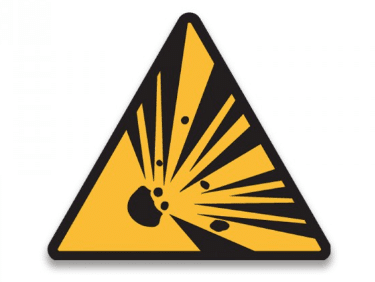
Risk of explosion: If ignition comes into contact with a cloud of explosive dust, an explosion may occur. The consequences can be severe, leading to major property damage, serious injury and even loss of life.
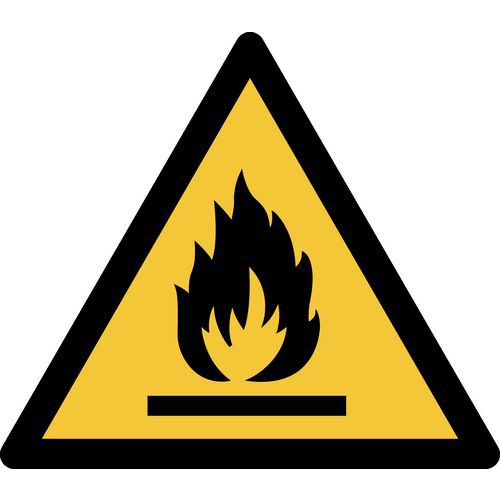
Fire hazard: These can also cause fires. If an ignition source, such as a spark, comes into contact with accumulated dust, a fire can start and spread rapidly.
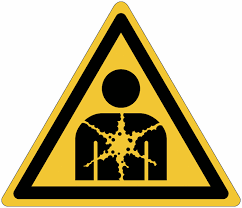
Health hazard: Inhalation of these flammable dusts may cause lung problems, respiratory tract irritation, allergies or other more serious ailments.
Regulations and standards governing the removal of explosive dust
Dust control regulations and standards vary from country to country. Here are the regulations and standards for Europe:

- ATEX Directive: The European Union has adopted the ATEX (Explosive Atmospheres) Directive, designed to protect workers against the threat of explosions. The directive lays down minimum requirements for explosion protection, requiring hazard assessment, implementation of appropriate preventive measures and classification of hazardous areas.
- Standard EN 15089: This European standard specifies the requirements for dust collectors used in installations where combustible dusts are present. It covers aspects such as the design, installation, operation and maintenance of an industrial dust collector.
It is important to note that these examples are not exhaustive, and that there are other regulations and standards specific to each country. Companies must comply with the regulations in force in their respective jurisdictions, and consult the relevant authorities or security experts for advice specific to their industry and location.
In addition, it is essential to take into account the guidelines and recommendations of manufacturers of specific equipment used in dust collectors, as they can provide precise instructions for the installation, use and maintenance of their products to ensure dust safety.
Minimize the risks associated with explosive dusts
To minimize risks, it is crucial to implement appropriate preventive measures, such as :
- Install an efficient dust collector to eliminate dust build-up.
- Use appropriate equipment and procedures to reduce dust generation.
- Ensure that hazardous areas are properly ventilated.
- Control potential ignition sources and implement spark protection measures.
- Train personnel on the dangers of explosive dust, preventive measures and emergency procedures in the event of an incident.
Compliance with local regulations and safety standards is essential to reduce dust-related hazards. Industrial safety experts and qualified professionals should be consulted to assess and implement appropriate safety measures in the work environments concerned.
The different classifications of explosive dusts
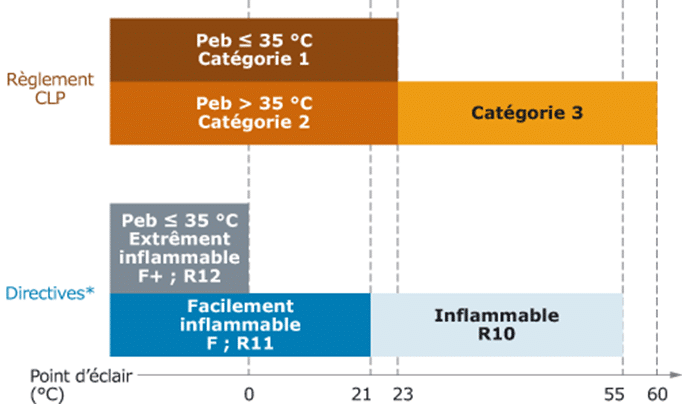
They are classified according to their flammability and their capacity to cause an explosion. Different cClassifications are used to assess the level of hazard associated with each type of explosive dust. Here are some of the commonly used classifications:
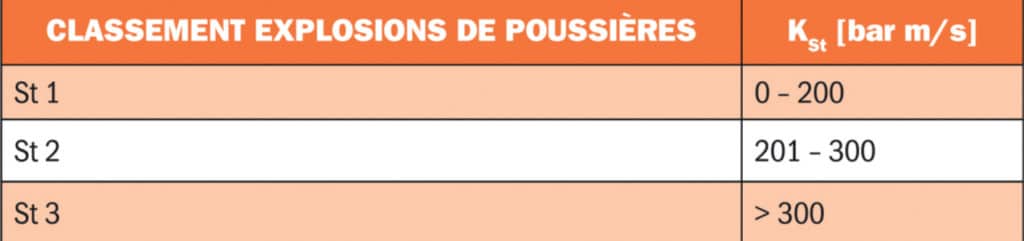
Classification from St1 to St3 : This classification is based on the severity of the dust explosion. Classes St1 to St3 represent increasing levels of severity, with St1 being the least severe and St3 the most severe.

The KST index measures the speed of explosion pressure rise. It is measured in bar.m/sec. The higher the Kst value, the more dangerous the explosion caused by the powder.
Flammable dusts are classified in one of the following four classes: St0, St1, St2, St3. The severity of the explosion increases with the class number. A material with zero explosion risk (Kst = 0) belongs to class St0.
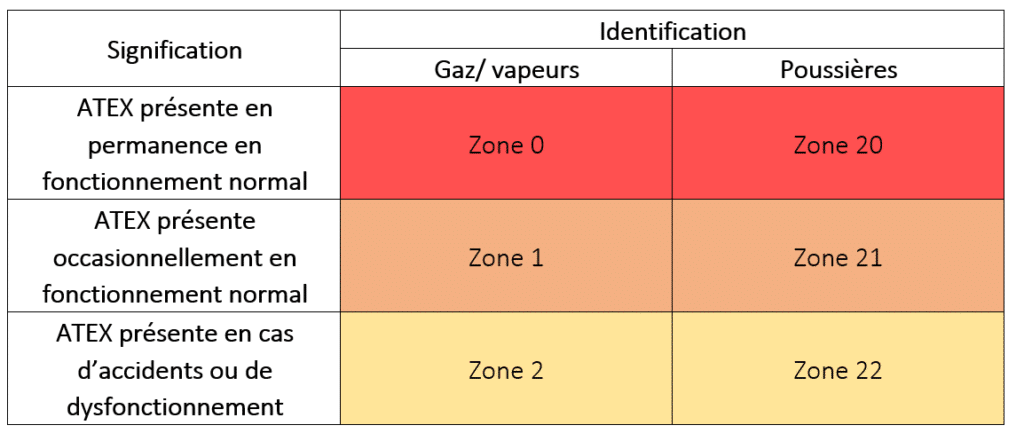
ATEX classification: ATEX classification is based on European directives on explosive atmospheres. Dusts are classified into groups and zones according to their flammability and explosiveness. Groups include non-combustible (Group IIIA), combustible (Group IIIB), and conductive (Group IIIC).
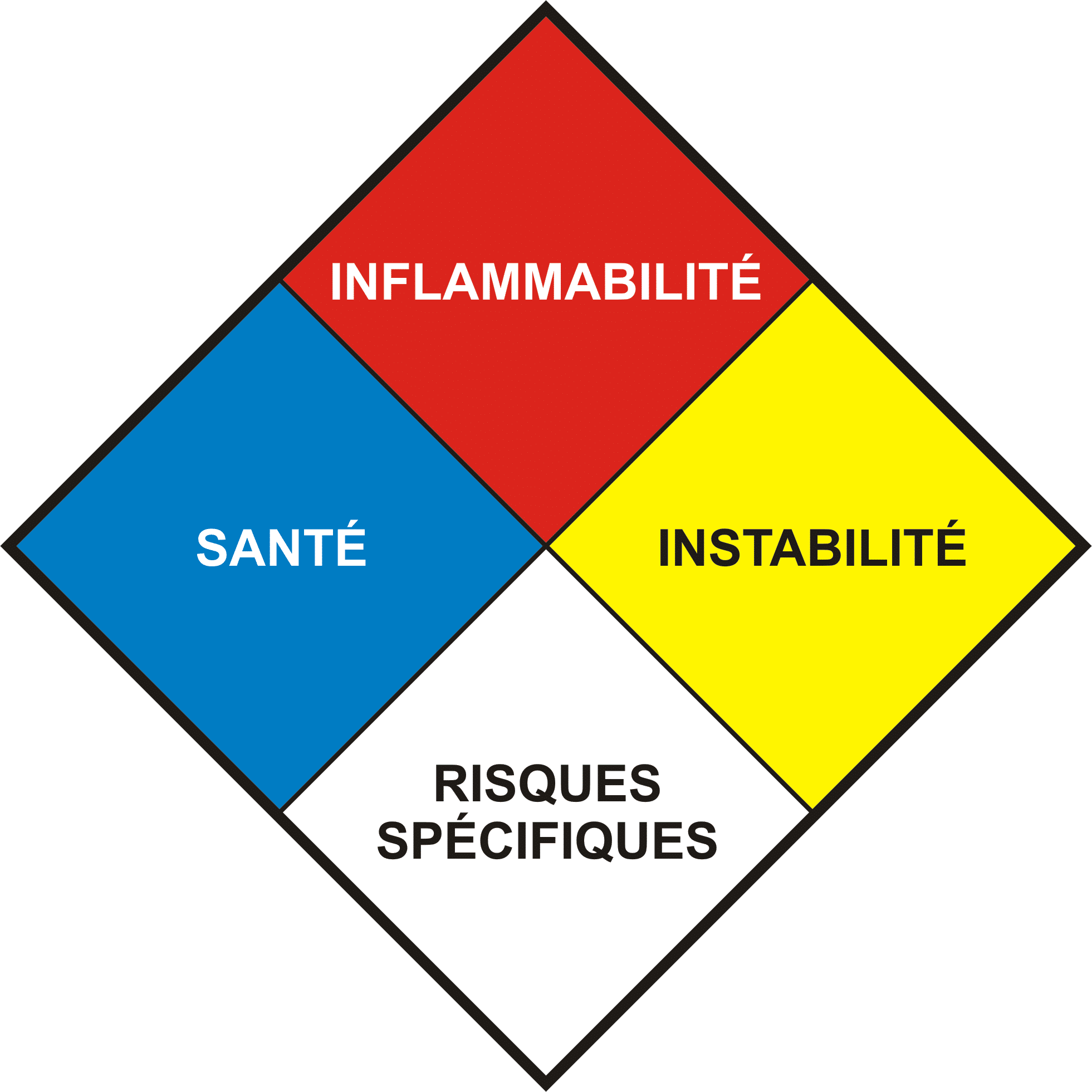
NFPA rating: The National Fire Protection Association (NFPA) uses the NFPA 499 rating to assess dust explosion threats. Dusts are classified into combustible classes (Classes II and III). III) and non-combustible classes (Class IV). Each class is then divided into sub-classes according to the dust’s combustibility, ignition energy and electrical conductivity.
Kst rating: The Kst (deflagration constant) rating is used to assess the propagation speed of explosions in dust. It is based on the maximum pressure developed during an explosion. Dusts are classified according to their Kst, from Kst 0 to Kst 300, representing an increasing scale of explosion risk.
It is important to know and understand the classification of ATEX dusts in order to take appropriate safety measures in the environments where they are present. This enables risk management procedures to be put in place and the right equipment to be selected to prevent explosions and ensure worker safety.
Flammable dust characteristics
These are combustible solid particles which, when dispersed in the air, can form a potentially dangerous explosive mixture. These dusts are often produced during industrial processes such as the handling, grinding, mixing, drying or combustion of solid materials.
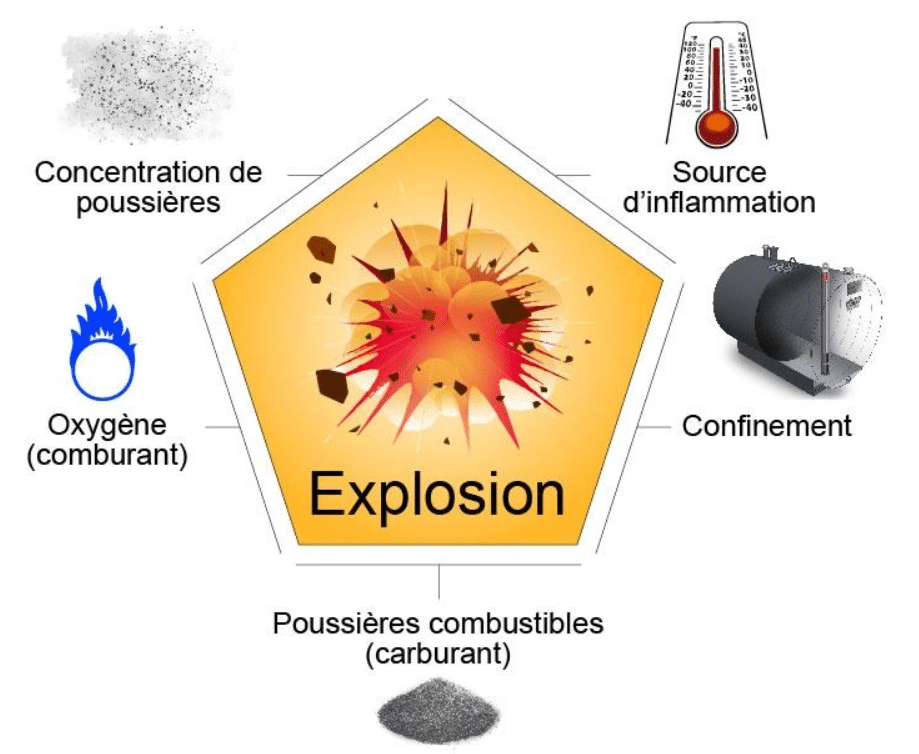
Combustibility: Dust has the ability to burn or ignite when exposed to a source of combustion, such as a spark, open flame, high temperature or electrostatic discharge.
Particle size: Dust can vary in particle size. Finer particles tend to be more flammable and can present a higher explosion threat, as they have a greater specific surface area, favoring faster combustion.
Critical concentration: There is a critical concentration of flammable dusts in air, known as the lower explosive limit (LEL) or minimum explosive concentration (MEC). Below this concentration, the air/dust mixture is not flammable enough to cause an explosion. Above this concentration, if combustion is present, an explosive mixture may form.
Sensitivity to activation energy: Flammable dusts can react to various sources of activation energy, such as heat, electric sparks, electrostatic discharge and hot surfaces. It is important to minimize or eliminate these energies in areas where dust is present, to prevent the risk of explosion.
Rapid combustion: When flammable dust is exposed to a combustion source, it can burn very rapidly, generating a shock wave and a rapid rise in pressure. This can lead to a violent explosion and serious damage to plant and equipment.
Explosion propagation: An initial explosion in an area containing flammable dusts may cause the explosion to spread to other areas where mixtures are present. This can lead to secondary explosions, increasing damage and danger to workers.
Combustible dust characteristics
These are solid particles which, when dispersed in the air, can catch fire and burn in the presence of ignition. These dusts can come from a variety of sources, such as raw materials, finished products, production processes or solid material handling activities. Here are some of the key properties of combustible dusts:
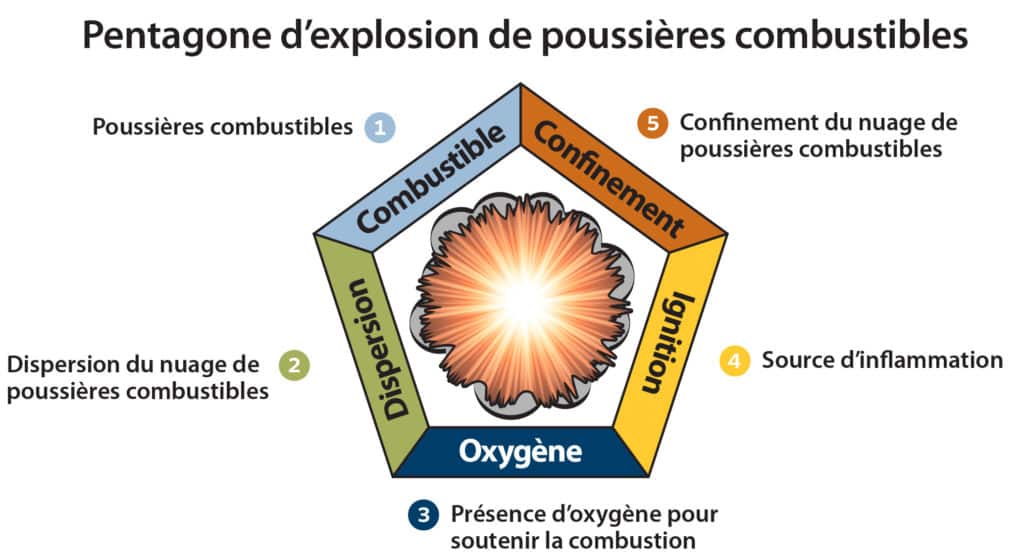
Flammability: They have the ability to burn when exposed to a source of ignition, such as a spark, open flame, high temperature or electrostatic discharge. They are capable ofsustaining a combustion reaction once a sufficient energy source is present.
Particle size:Particles can vary in size. Finer particles have a greater specific surface area, making them more reactive and more likely to ignite quickly. Very fine dust can form explosive dust clouds when dispersed in the air.
Explosive concentration: There is a concentration range of flammable dusts in air, known as the explosive limit, where the air-dust mixture is sufficiently flammable to cause an explosion. This range includes the lower explosive limit (LEL), which represents the minimum dust concentration required for ignition, and the upper explosive limit (UEL), which represents the maximum dust concentration before the mixture becomes too rich to burn.
Rapid combustion: When flammable dust is exposed to a combustion source, it can burn rapidly with a significant release of energy. This can cause explosive combustion, resulting in a shock wave, high pressure and considerable damage to the environment, infrastructure and people in the area.
Sensitivity to ignition sources: Flammable dusts can be sensitive to various ignition sources, such as heat, electric sparks, hot surfaces, electrostatic discharge and electric arcs. It is essential to minimize or eliminate these potential combustions in spaces where dust is present, to prevent the risk of explosion.
Explosion propagation: An initial explosion in a space containing flammable dusts can lead to propagation of the explosion to other areas where explosive mixtures are present. This can lead to dangerous situations with secondary explosions and widespread damage.
Update on pyrophoric dust :
These are solid substances that can ignite spontaneously in contact with ambient air, without the need for an external combustion source such as a spark or open flame. These substances are often highly reactive materials that react violently with oxygen in the air, generating hazards such as :
Spontaneous flammability: Pyrophoric dusts may ignite instantly when exposed to air. This can lead to rapid, violent fires that are difficult to control. The resulting flames can spread rapidly and cause major property damage.
Explosion hazard: In certain situations, pyrophoric dusts can form explosive mixtures with air. If an explosive concentration is reached and a combustion source is present, an explosion can occur, causing widespread damage, serious injury and even loss of life.
Toxicity and health hazards: Some pyrophoric materials can produce toxic gases when burned. These gases can be harmful to human health, causing respiratory tract irritation, chemical burns and other adverse effects.
Chemical reactivity: Pyrophoric dusts can react violently with other chemicals, leading to chain reactions and uncontrolled exothermic reactions. This can lead to intense heat emissions, off-gassing and explosions.
Explosive dust fire and explosion scenarios
They present a significant fire and explosion hazard under certain conditions. Here are some common scenarios:
- Cloud combustion: When dust is dispersed in the air as a cloud and comes into contact with combustion such as a spark, open flame or hot surface, rapid and violent combustion can occur. This can lead to an explosion with a sudden release of a shock wave and rapid spread of fire.
- Dust accumulation: Dust can accumulate in work areas, particularly on horizontal surfaces and in hard-to-reach corners. If enough dust accumulates, it can form a combustible layer. When combustion is present, such as electrostatic sparking or overheating, dust accumulation can ignite and cause a fire or explosion.
- Deflagration in ducts or conveying systems: Dust can propagate in ducts, pipes or conveying systems such as conveyors. If explosive dust is confined in a small space and comes into contact with combustion, it can trigger a deflagration. Deflagrations can spread rapidly along ducts and cause significant damage.
- Exothermic chemical reactions: Some explosive dusts can react chemically exothermically, i.e. by releasing heat. If the reaction is sufficiently rapid and intense, it can cause a rapid rise in temperature and combustion of the surrounding dust. This can lead to fire or explosion.
- Ignition by energy sources: Dust can be ignited by a variety of energy sources, such as electrical sparks, hot surfaces, open flames, mechanical sparks or electrostatic discharges. Even seemingly harmless dust can be ignited under the right conditions.
Industries that may present a high dust threat according to the ATEX directive (Explosive Atmospheres) include :
- Chemical industry: Chemical production plants, chemical manufacturing plants and chemical storage facilities can generate dust during handling, mixing, grinding or sieving processes.
- Pharmaceutical industry: Pharmaceutical industries involved in the production of drugs, solid pharmaceutical products, powders or tablets can generate potential dust during manufacturing processes and product handling.
- Food industry: Food processing plants, flour mills, grain silos, food drying or roasting facilities can produce dust. Flour, sugar, spices, cereals and dairy products can generate explosive atmospheres.
- Wood industry: Sawmills, wood processing plants, particleboard, plywood and wood fiber production facilities can generate dust, mainly from wood chips and sawdust.
- Metallurgy: Foundries, steelworks, welding shops and metal processing facilities can produce metal dusts, such as aluminum, magnesium or titanium, which can present an explosion hazard.
- Paint and coatings: Paint, varnish, coating or solvent production facilities can generate explosive atmospheres due to volatile solvents and pigment dust.
- Explosives and ammunition: Facilities manufacturing explosives, gunpowder, ammunition and fireworks present an intrinsic explosion hazard due to the very nature of the materials handled.
- Stone and minerals: The threat of explosion in the stone sector is amplified by the size of the dust particles and their suspension in the air. When these particles reach a certain concentration in the atmosphere and come into contact with combustion, such as an electric spark, open flame or hot surface, an explosion can occur.
