Sommaire
Adapt to the spatial constraints of the operation emitting the gas or vapour ATEX
ATEX suction arms and laboratory arms
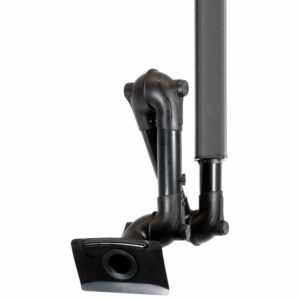
Employers will choose ATEX suction arms or ATEX laboratory arms for their flexibility of positioning in space. In fact, they meet the combined constraints of :
- optimized positioning of the extraction point within a volume limited by the workstation and the vicinity of adjacent installations,
- proximity of the sensor to the emission source for optimum collection area,
- adaptability to work on large parts, or operations requiring different worker positions, etc.
Suction arms are ideal for jobs that don’t require frequent changes in the position of the suction mouth.
ATEX industrial fume hoods
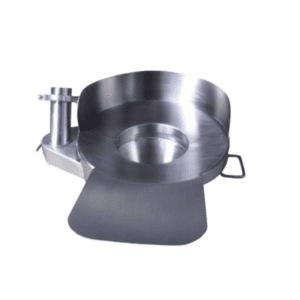
The lower the explosive limit, or the more flammable gaseous products the operation emits, the larger the extraction hood needs to be. ATEX industrial rectangular f ume hoods can be adapted to suit the extraction arm, providing a large extraction surface as close as possible to the source.
ATEX fixed hoods
However, ATEX suction and collection hoods are used in static installation configurations at the workstation or on an industrial machine.
Maximum enclosure of the ATEX gas or vapour emission zone
If the explosive limit is too low, or the quantity of gas/vapour emitted is too great, the employer will opt for ATEX capture devices that encompass the entire workstation in the suction volume: ATEX suction tables, ATEX suction backsplashes, ATEX modular capture hoods, capture rings.
ATEX vacuum tables
Suction tables are work surfaces which, depending on the purpose of the work, feature either a horizontal suction slot in the background, or suction slots running lengthwise along the table surface. The aim is to produce asuction flowevenly distributed over the entire work surface. The aim is to generate a downward flow, directing flammable substances towards the work surface. The flow loaded with flammable ATEX substances is directed towards a centralized or localized filtration system. In the latter case, the suction table is mobile, and can generally release the filtered air back into the workshop.
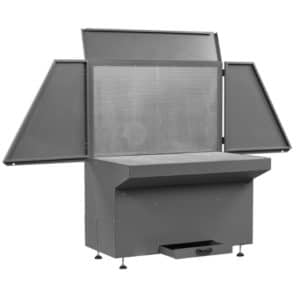
Suction tables are ideal for jobs requiring a limited work surface. Their use therefore depends on the size of the elements to be worked on, and the space required for operational gestures. They correspond to operations requiring frequent changes in the spatial position of the emission source , which would necessitate over-frequent repositioning of a suction arm, for example. On the other hand, as they are placed under the source of flammable substances, they correspond well to the dilution of ATEX in operations generating vapors or gases heavier than air.
ATEX suction backsplashes
ATEX suction backsplashes are vertical walls used as suction outlets, positioned behind or next to the ATEX source. A ladder of horizontal suction slots sized to the length of the workspace covers the height of the vertical wall. The ATEX suction backsplash creates a physical barrier between the operator and the hazardous area. To do this, it vacuums the entire work volume horizontally. In fact, suction is evenly distributed over the entire vertical wall, both in height and length. The homogeneous air flow moves away from the operator towards the suction wall; thesource of ATEX emissions is located in the flow path. The suction backsplash allows longer operating areas to be suctioned than suction tables. It is well suited to operations on bulky objects, or if the operations involve vertical or horizontal movements of the emission source (e.g.: several operating points on a bulky object).
ATEX ring collector
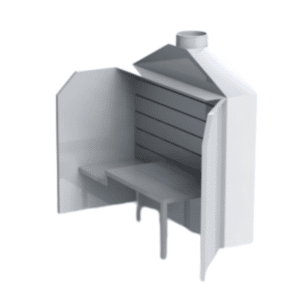
Ring catchers, or pouyès rings, are used for decanting, filling, emptying, sampling and mixing flammable liquids in reactors, tanks, drums, etc. with circular openings. In these operations, the opening of these confined volumes generates the emission of vapors. Their concentration can be close to the flash point, creating risks of explosion. The principle is to encircle the source of emission. As a result, the annular collection device is equipped with a peripheral suction slot. This extracts the vapors over the entire opening surface. A semi-circular hood, or more, open on the side where the worker is operating, avoids dispersing vapors into the room, while still allowing operations at the circular opening. Suction speed ensures that vapors are kept out of reach of the operator’s inhalation zone.