Sommaire
Dust collectors and industrial vacuum cleaners
A dust collector extracts airborne or moving dust or smoke, while an industrial vacuum cleaner must extract settled dust particles and larger impurities. To meet these different objectives, the devices primarily utilize volumetric flow and negative pressure in opposing ways.
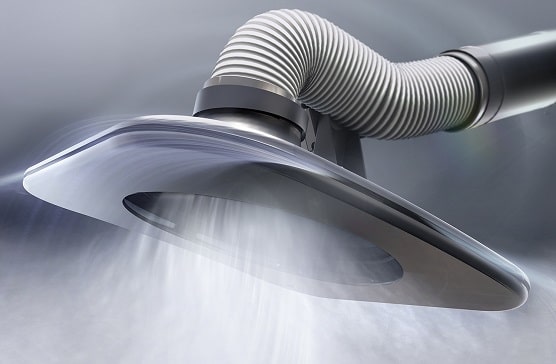
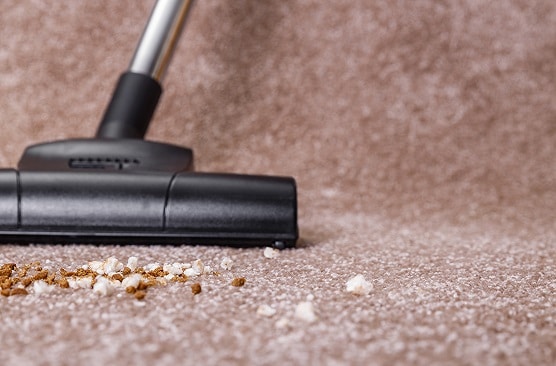
To extract pollutants, a dust collector requires high flow and low negative pressure. Conversely, to extract and remove dust from surfaces, an industrial vacuum cleaner requires high negative pressure but low flow. The following comparison between an OberA dust collector and an OberA industrial vacuum cleaner, each with a power of 2.2 kW, illustrates how they are used in opposing ways:
| Dust collector (DUSTOMAT 4-10) | Industrial vacuum cleaner (EUROSOG-I-D) | |
| Max. negative pressure (Pa) | 2.600 | 19.500 |
| Max. airflow (m³/h) | 2.000 | 360 |
| Connection (mm) | 160 | 50 |
Mobile extraction units and dust collectors are generally classified as low and medium pressure extraction systems. Centralized cleaning extraction systems and vacuum cleaners are generally classified as high-pressure extraction systems. Between these two categories, with equivalent electrical power, there is almost a factor of 10 difference in terms of pressure and flow.
For a better understanding of this principle, the terms“volumetric flow” and“vacuum” are defined in greater detail below.
What is volumetric flow?
A volumetric flow is the volume of a fluid (gas or liquid) that moves through a defined cross-section (e.g., a pipe) in a given time. For this movement to occur, there must always be a pressure difference between at least two spaces/volumes. In the case of an extraction system, volumetric flow describes the quantity of air circulating through an extraction pipe in a given time. We also encounter volumetric flow in everyday life, for example, at the tap, in rivers and streams, but also in gaseous form: in the air, in air conditioners and fans.
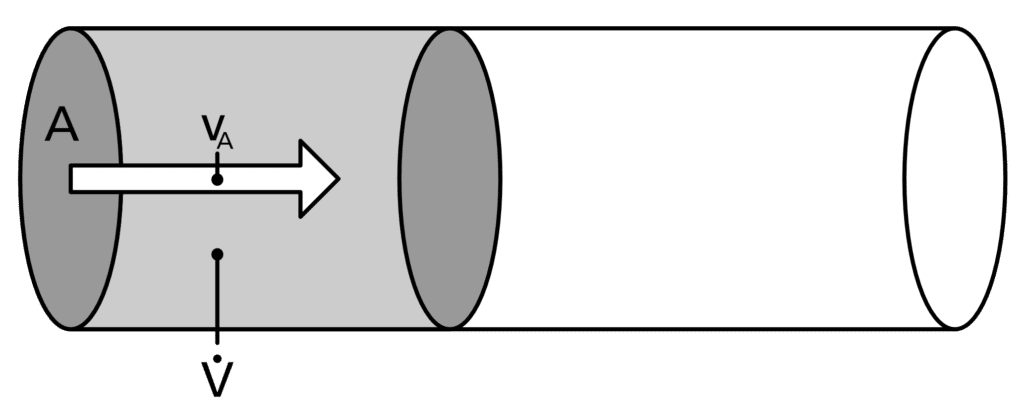
The common unit for volumetric flow is m³/h. Volumetric flow is calculated using the following formula: V = vA * A
V = Volumetric flow | vA = Average flow velocity [m/h] | A = Cross-sectional area at the point considered in [m²]
So, for an air flow rate of 2,000 m³/h, 2,000 cubic meters of air flow per hour through the defined cross-section of a duct.
For example: 2,000 m3/h flow at a speed of 22 m/s (78km/h) in a d180mm pipe, or at a speed of 18 m/s (64 km/h) in a d200mm pipe.
What is depression?
The term vacuum refers to the pressure in a defined volume, as long as it is lower than the environmental pressure.
The term negative pressure is only appropriate if a reference pressure exists. In current standards, the value of one bar (1 bar) is used as the reference pressure. The old unit of measurement for negative pressure was atmosphere; since 1978, the bar has been used. Since the negative pressure value is lower than the reference pressure, it is also called vacuum pressure.
If air is extracted with a fan, for example, an air suction occurs that can cause negative pressure. However, this effect is almost compensated by the influx of air in an unlimited space. However, if the space is limited (e.g., by a duct), a defined negative pressure is established depending on the volumetric flow and the diameter of the duct. The operating principle of a vacuum cleaner is based on this type of negative pressure generation. The housing of a vacuum cleaner contains a blower that draws air through the vacuum tube and expels it at the other end. The resulting negative pressure allows ambient air and thus dirt particles to be drawn into the vacuum cleaner. Negative pressure increases when the cross-sectional area remains the same and the blower is more powerful. The same applies when the cross-sectional area decreases and the blower power remains constant.
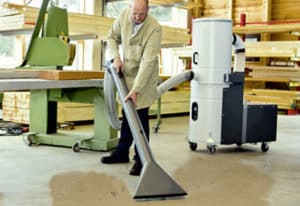
It can therefore be understood that an industrial vacuum cleaner uses high negative pressure to create sufficient force to extract larger, settled particles. A high flow rate is not necessary for this purpose. However, since dust collectors are designed to clean large volumes of air, a high flow rate is essential. Fumes and airborne dust are small and light particles. They can therefore be extracted without excessive negative pressure.
The right vacuum system
Industrial dust collectors
For dust collection applications, OberA offers, for example, the mobile dust collector DUSTOMAT 4, the stationary dust collector ESTMAC, or the modular stationary dust collection system DUSTMAC. For these three dust collectors, the suction and filtration power can be scaled.
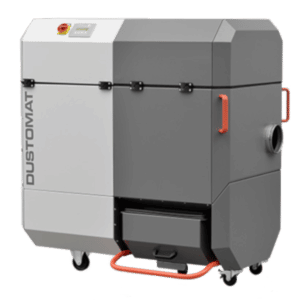
Versatile, energy-efficient unit: can be used as a mobile dust and chip collector or as a filter for welding fumes.
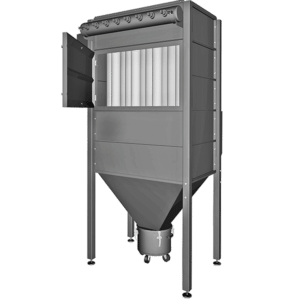
Bag filter systems for extraction of sticky dusts, or cartridge filters for extraction of dry, fluid, non-explosive dusts.
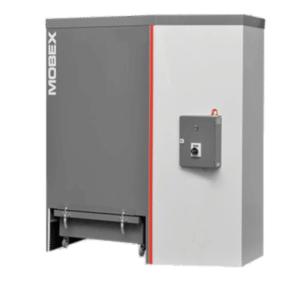
Suitable for all industrial sectors and almost all types of dust and swarf for single or multi-shift extraction.
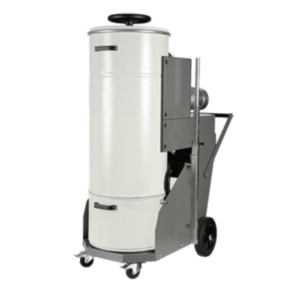
Mobile dust collector for extraction of a wide range of dusts, such as mineral dust.
