Innovation in dust removal and filtration of industrial emissions is focused on filtration materials and equipment control and maintenance technologies. It aims to improve the practicality and efficiency of dust removal systems.
Sommaire
Current innovation trends in dust collectors and air filters
Innovations in remote maintenanceof dust removal systems and filtration equipment :
The integration of sensors and “Internet of Things” technologies aims to provide real-time information on the behavior of the dust collection system, and to share this information between the manufacturer and his supplier. For example, modem cases enable remote maintenance of dust collectors. The aim is to be able to share the main operating parameters of a suction system between the operator and the manufacturer in real time or on demand (delta P clogging, power consumption, fault history, number of operating hours, operation of various sub-units, etc.). These solutions make it possible to monitor the evolution of a plant more precisely, increasing its reliability while reducing the number of maintenance technician visits.
Innovations in energy savings :
Precise control of unclogging is one example. Compressed air is an expensive fluid. Precise control reduces compressed air consumption. The unclogging process will start at just the right moment (programmed time or pressure difference). This reduces the number of cleaning operations, and consequently the wear and tear and consumption of filter media. What’s more, the new dedusting equipment is designed to be energy-efficient. For example, the use of new venturi compressed air injection nozzles in cleaning operations reduces compressed air consumption by 20% to 40%, for the same cleaning effect.
Last but not least, precise control of the suction flow can lead to substantial savings. In fact, a fan’s power is directly proportional to the intake flow rate. It is therefore important not to oversize suction rates. Other solutions involve equipping the fan with a variable frequency drive and adjusting the flow rate according to the suction requirement. The frequency converter adapts the suction power to a set vacuum or flow rate, or to the number of machines to be vacuumed. Acting on the flow rate can significantly reduce fan power consumption, as well as heating consumption when the intake air is exhausted to the outside.
Innovations in filtration technology
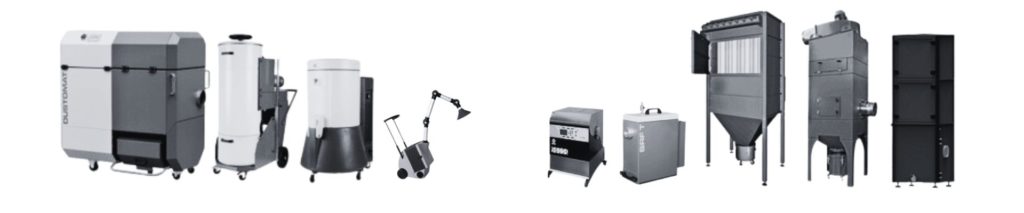
The diversity of particle emissions from a given activity is matched by an innovation in use: additive filtration. This involves serializing a set of specialized filter media in a dust collector to capture all dust and VOCs from an industrial process (e.g. Dustomat 24, ePUR Box). The result is a customized, adaptive solution. For example, the working of composite materials, laser welding and 3D printing generate emissions of different types and structures: dust, very fine fumes and gaseous compounds (VOCs, odors, etc.).
Innovation in materials and filter media design focuses on nanotechnologies and biomimicry. Nanomaterials are created that specialize in the filtration of one type of molecule (CO2 CH4), or on the contrary, are capable of capturing a diversity of particles emitted by an industrial process.
Focus on innovative materials for air particle detection, filtration and neutralization
Nanofabrication of a filter from corn proteins
The development of environmentally-friendly materials is one avenue for innovation. For example, a filter media was nanofabricated from corn proteins. This filter can capture 99.5% of particles like current HEPA filters, but also 87% of formaldehydes. This latter performance is superior to that of filters specializing in this type of toxic molecule. The capture mechanism relies on the ability of functional groups on the protein’s surface to act like molecule-catching tentacles. The simultaneous capture of different gas molecules is envisaged thanks to the rearrangement of the protein’s amino acids. What’s more, as the protein is hydrophobic, the filter can be used in humid air.
Neutralization of toxic molecules
One innovation concerns the nanofabrication of a multicomponent fiber integrating a photocatalytic agent into the fiber structure. It destroys VOCs, odors and pathogens, while avoiding the release of secondary pollutants. The biomimicry of the structure is similar to that of the diatom to maximize exchanges between the air and the purifying agent. This innovation can replace activated carbon filters, with less maintenance and lower filtration energy. This innovation has been patented by the French company Purenat.
Another source of innovation is the surface treatment of filter fabrics. A new coating uses a copper precursor to create a conductive metal-organic structure. This transforms toxic gases into neutral matter: nitric oxide is converted into nitrite and nitrate, and hydrogen sulfide into copper sulfate. The metal-organic structure integrated into cotton or polyester creates a reactive, reusable material. Surface treatment can be used to create specific patterns and precisely fill the spaces between fabric threads. This material is resistant to wear, tear and standard washing. It can be used for intelligent filters, environmental sensors and personal protective equipment.
Innovation in aerosol pathogen capture and detection.
New anti-allergenic and antibacterial technologies are integrated into the materials to provide a healthier environment. Some components of dust removal units may be made of this material in the future.
In spite of rigorous cleaning and disinfection procedures , the risk of infection exists in the hospital environment. In response, a plastic material, acrylonitrile butadiene styrene (or ABS), widely used in hospital equipment (and automotive or household appliance casings, telephony, IT, in 3D printing wire), was fused with chlorhexidine. The result is a new surface treatment material capable of killing bacteria in 30 minutes. This innovation overcomes the disadvantages of conventional disinfectants, which spread into the air and escape from surfaces when touched. We plan to add this new material when we manufacture the plastic.
In the same vein, an antimicrobial, antifungal and antiviral surface treatment based on chlorhexidine digluconate has been developed for use with filter media on the market. The technology was tested on trains in the UK rail network before being patented.
Last but not least, an innovation in the surface coating of filter media aims to advance air bio-sampling. The aim is to detect and identify the nature of bacteria and viruses as early as possible, by capturing them alive. A prerequisite for early identification of a biological hazard. While HEPA filters are effective at capturing pathogens, they are ineffective at keeping them alive. The innovation consists of a composite membrane with a liquid layer designed to preserve the viability of bacterial or viral samples captured for laboratory examination.
Innovation in filtration at the source of industrialCO2 emissions
Filtering carbon dioxide emissions at source in industry means improving separation materials.
Si-CHA is a silica-based crystalline structure used to create a uniformly porous membrane that separates carbon dioxide from methane or other larger molecules. The development of a method for synthesizing a pure Si-CHA membrane increasesCO2 separation performance while consuming less manufacturing time and energy. Research is continuing to industrialize this process.
Another innovation uses market membranes a to improve theirCO2 selectivity. This nanomanufacturing technology grows hydrophilic,CO2-permeable polymer chains on the membrane surface. The result is a 150-fold increase in theCO2 selectivity of commercially available membranes. Modified membranes remain profitable, despite the additional cost of nano manufacturing. Initially developed for power plants, this new membrane technology will be optimized and diversified to other polymers in partnership with manufacturers to meet their specific needs.
A textile innovation for filteringCO2 from power plants boasts an 80% capture rate. It incorporates the natural enzyme carbonic anhydrase into a cotton fabric, accelerating the reaction that transforms water andCO2 into bicarbonate. The air then passes through the filter at a speed of 4l/min, a far cry from the 10 million liters of air required for a power plant. But since the filter is manufactured using traditional textile industry methods, industrial scale-up is easier and will be the subject of the next step. Filter performance tests after washing, drying and storage cycles have also confirmed that the filter’s performance has been maintained.
3D printing ofCO2 filters, using a hydrogel containing the enzyme carbonic anhydrase as the base material, is another avenue of innovation. This technology has made it possible to extrude a 1D wire and a 2D structure. It aims for versatility and acceleration in the design ofCO2 filters. The manufacture of a filter with a diameter of less than 2 cm for experimental purposes has so far only produced a capture rate of 24%, and after 1,000 hours of operation this rate is halved. To increase it, researchers are consideringstacking modular elements. This research is still in its infancy.
Another technological innovation inCO2 capture involves the use of an innovative polymer filter containing copper. This filter convertsCO2 essentially into sodium bicarbonate. This new hybrid material is a sorbent that is mechanically solid and chemically stable. It captures 3 times moreCO2 than current direct air capture techniques. Whatever theCO2 concentration level (natural to industrial), capture continues until the filter is saturated. Once the filter is saturated, a stream of salt water flows through the filter, converting theCO2 into sodium bicarbonate. The latter can be discharged into the sea without any negative impact. We can also use existing techniques to: desorb the filter (flow of hot water or steam), recover, compress and store theCO2.
Industrialization of nano-dust suppression technologies for surface treatment
Anti-dust technologies have been around for a long time. However, they never progressed beyond the research stage, as it proved too difficult to bring them to industrial scale. New manufacturing concepts have overcome this obstacle. Nano jamming and nano printing modernize a 19th-century newspaper printing technique. They deposit nanometric pyramidal structures that prevent dust from adhering. This innovation makes many types of material dust-resistant. Future applications on industrial equipment are now conceivable, notably on the internal surfaces of dust collection system components and on the external surfaces of equipment.
