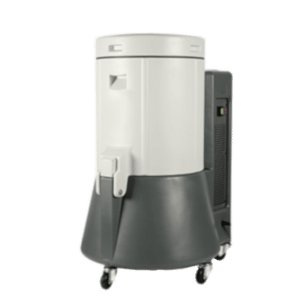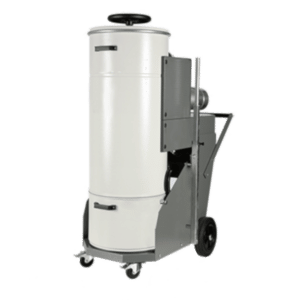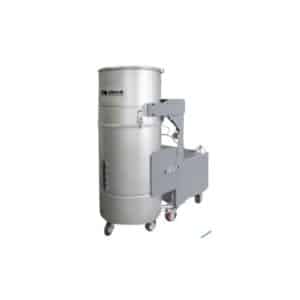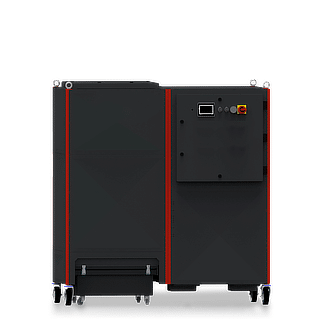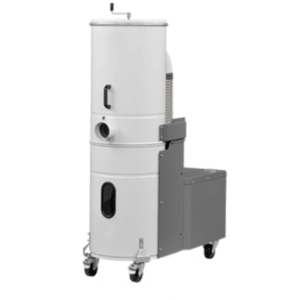
The dust-laden air is drawn in via a suction arm, an extraction hood or directly via a network of ducts. Once inside the dust collector, coarse dust particles fall directly into a collection tray.
Small dust particles are captured by one of the many filter stages. The clean air is discharged directly into your workspace. When the air filters are saturated with dust, they can be cleaned using several cleaning systems (depending on option).
A manual dust cleaning system, with a filter brushing system, an automatic cleaning system using compressed air or an automatic pneumatic cleaning system.
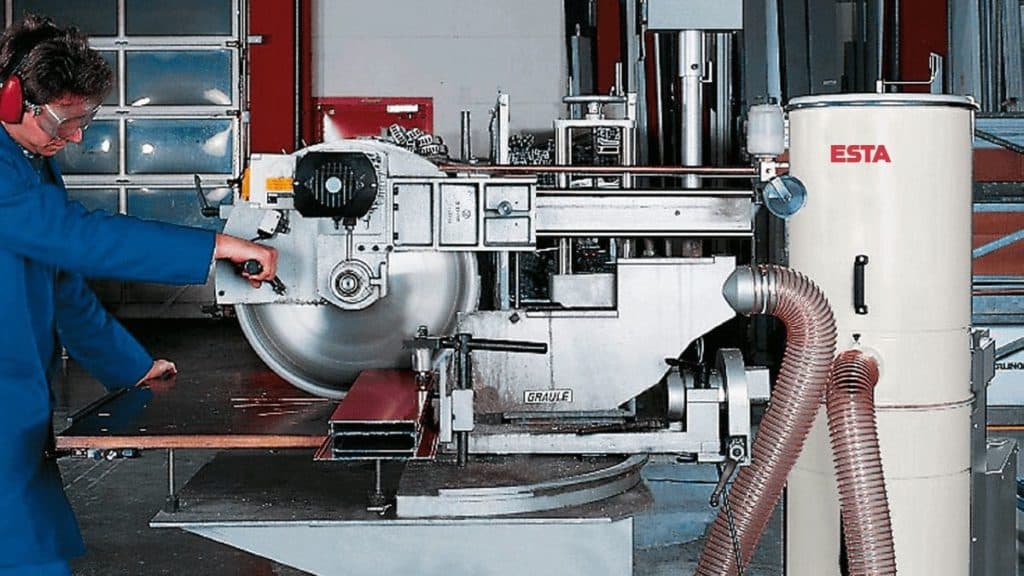
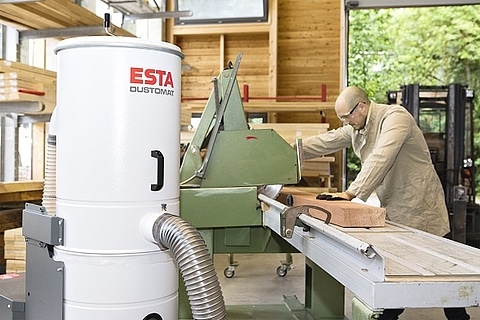
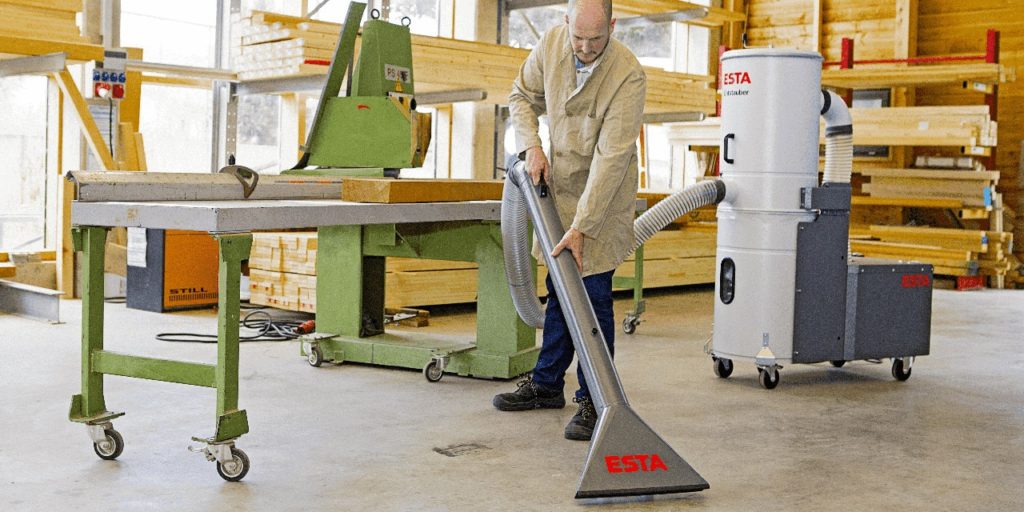
How does our mobile dust extraction system work?
Industrial dust extraction is essential in many industrial processes. There are several types of dust collector: mobile dust collectors and fixed dust collectors.
Indeed, most industrial activities generate dust, fumes or pollutants during manufacturing or transformation processes, such as cutting, sawing and shearing, which generate dust; welding and brazing, which generate fumes; grinding and polishing, which generate fine dust; machining, milling and turning, which generate chips, fumes and oil mist; and powder handling operations such as decanting, filling, emptying, mixing and weighing, which generate dust.
Most of the time, this dust generated during industrial processes has to be extracted.
- An industrial extraction system is generally needed first to protect operators from inhaling these fine dusts. Professionals are aware of the need to protect their operators in order to preserve their health and offer them better working conditions. On the other hand, manufacturers are not always aware of the maximum dust concentrations to be respected, and in particular of the exposure limit values defined by regulations.
- What’s more, when we’re dealing with explosive dusts (e.g. wood, aluminum, titanium, cereals, carbon fibers), an efficient extraction system is generally a must in order to keep explosive atmosphere zones (ATEX) as small as possible, and to control the risk of explosion or fire. Some processes generate high levels of explosive dust, which needs to be extracted as much as possible to keep production areas and machines clean, and prevent the spread of fire through structures, cable trays and so on.
- Finally, dust can also be the source of manufacturing defects and product rejects (product defects, aesthetic defects, cross-contamination, etc.). For sensitive products, a vacuum system is required.
There is often confusion about the terminology used by professionals. We talk about industrial vacuum cleaners, industrial vacuum cleaners,central vacuum cleaners and vacuum systems, and it’s not always easy to make sense of them all. Here are a few tips to avoid ending up with a small industrial vacuum cleaner when you’re looking for a machine vacuum!
Both products are equipped with filtration, but when we talk about industrial vacuum cleaners, we’re generally talking about a mobile high-pressure system for vacuuming floors or machine vents, requiring a high suction vacuum. . These high-pressure filtration systems generally come in diameters of 38mm, 50mm, 76mm, 80mm and 100mm, for suction flows of 80 to 300 m3/h and depressions of 15,000 to 30,000Pa (1,500 to 3,000 mm w.g.). These machines cansuck up dust, swarf and even liquids (water, oil, sludge, etc.) if they are designed for this purpose. Vacuum cleaners are generally available in single-phase versions up to 1.1 kW, and in three-phase versions above that.
Not to be confused with industrial suction or industrial suction and filtration systems, which are more generally understood to mean filters, filtration systems or low-pressure industrial dust collectors for suctioning machine inlets, or collection devices such as suction tables, suction arms, collection hoods, backsplashes, etc. The diameters of suction systems are generally between 100mm and 300mm at the inlets. Suction pressures are generally 10 times lower than on industrial vacuum cleaners , while flow rates are 10 times higher.
In a nutshell:
– Industrial vacuums = low flow + high vacuum Industrial vacuums = low vacuum + high flow
What applications is our Dustomat 10 dust collector designed for?
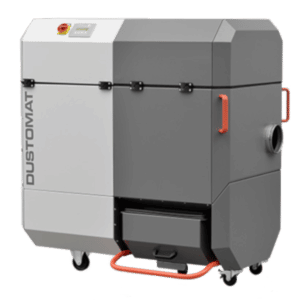
The DUSTOMAT 10 dust collector is equipped with filters designed to extract dust and swarf from mobile workstations. This mobile device is adaptable to a wide range of uses: direct collection on production machines, suction or collection via a suction arm or air extraction hood, etc.
This type of dust collector is designed to extract metal, plastic and wood chips and dust, as well as paper dust, tobacco fibers and colored pigments. These types of pollutants are frequently present in industries such as metallurgy, plastics, wood, paper and cardboard, as well as minerals during machining, cutting, milling or material separation, etc…
Pollutants


Industries


What are the features of our Dustomat 10 dust collection system?
The versatile DUSTOMAT 10 dust collector has a wide range of uses. It can be used as a vacuum cleaner, or collected as close as possible to the source using a suction arm, an air extraction hood, or directly connected to a production machine via a network of suction ducts. This high-powered mobile dust extraction system can handle air flows of up to 720 m3/h. It has a low noise level (72 dB) and consumes very little energy.
What’s more, the dust collector can be fitted with different types of cleaning devices (rotary brushes, compressed air or pneumatic jet) to clean the filters. Its castors and weight of 120 kg give it a firm foothold on the ground and good mobility. Its dust collector has a filling capacity of up to 100 liters.
The mobile dust collector can be equipped with a pre-separator for sparks and chips, and can be fitted with class M certified air filters or class H certified air filters (optional).
| Device | DUSTOMAT 10 | |
|---|---|---|
| Flow | m3/h | 720 |
| Inlet diameter | mm | 100 |
| max negative pressure | Pa | 2800 |
| Supply voltage | V | 230/400 |
| Power | kW | 1.3/1.1 |
| Filter surface | m² | 3.5 |
| Dimensions | l/L/h (mm) | 1165 x 530 x 1636 |
| Weight | kg | 120 |
| Noise level | dB(A) | 73 |
What are the advantages of our mobile dust collector?
The Dustomat 10 mobile dust collector offers general protection for employees against a wide range of respiratory and skin diseases. The unit’s power and versatility mean it can handle virtually any type of dust, and is suitable for a wide range of uses. Low maintenance costs are achieved by cleaning the filter media using a manual (rotary brushing) or automatic (compressed air or pneumatic jet) unclogging system, offering low maintenance costs and long operating life.
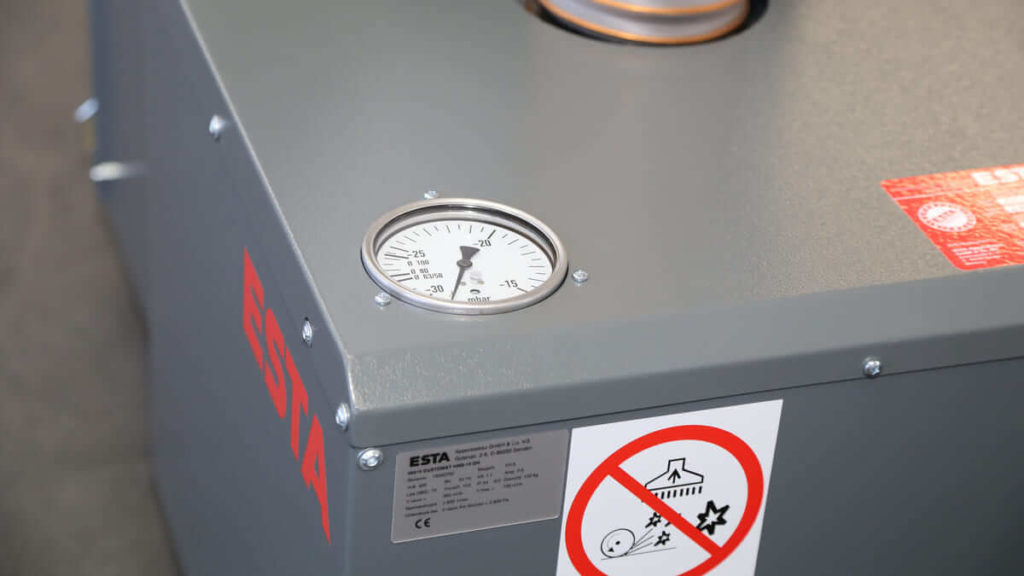
Waste collection is easy, thanks to the tilting bin on the bottom of the mobile dust collector. More to the point, our mobile filtration systems enable us to comply with the Occupational Exposure Limit Values (OELV).
Advantages
- Lower operating costs
- Mobile yet with high extraction performance
- Adaptable to a wide range of situations: direct collection on production machines, vacuum cleaners, or collection via a suction arm or hood…
- Suitable for most types of dust
Special features
- Filter cartridges cleaned by rotating brushes
Characteristics
- Ideal for individual workstations on a production machine or close to a manual work area
Optional


Accessories
Other mobile dust collectors from the brand oberA