Sommaire
Air Purification Equipment for Viruses and Bacteria
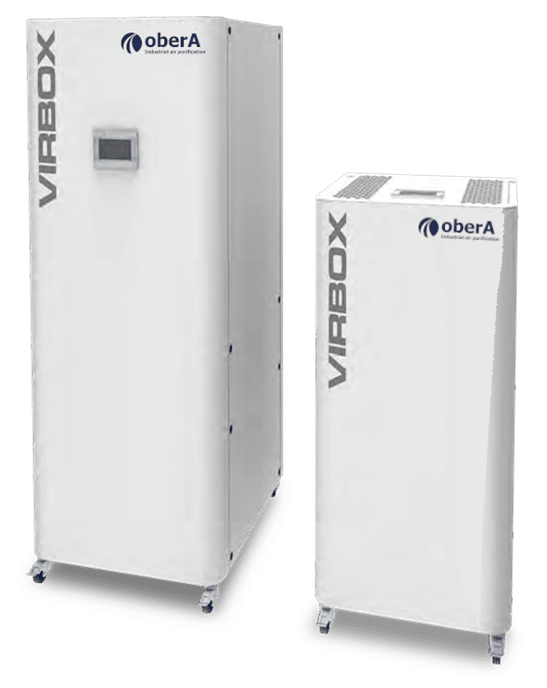
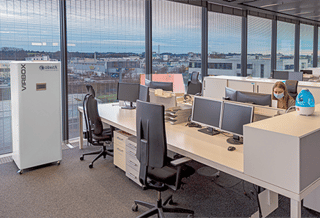
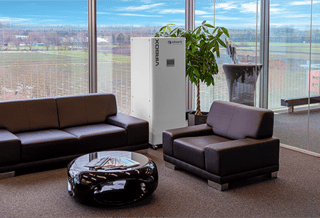
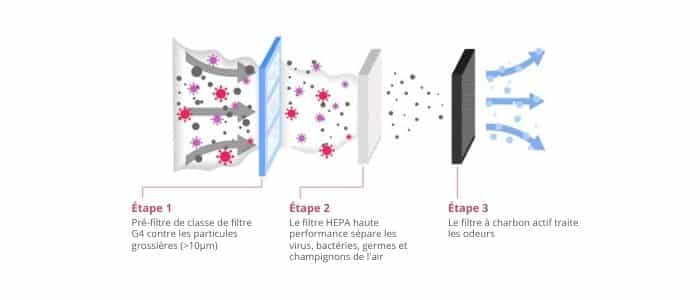
The Virbox air purifier draws in polluted air through a three-stage filter system. The filtered air is then returned to the room via ventilation grilles on top of the device. The air circulation system ensures permanent air filtration in enclosed spaces.
The Virbox can be connected to any standard household outlet.
The anti-virus purifier can be activated via a user-friendly touchscreen, and its suction capacity can be adjusted individually. With the optional CO² sensor, you can measure indoor air quality quickly and easily.
The Virbox is available in two versions, with different performance levels: Virbox 750 for areas up to 200m², and Virbox 1500 for areas up to 400m².
3-STAGE FILTRATION SYSTEM
BENEFITS
- Reduces the risk of infection in confined spaces
- Energy efficiency with the latest EC technology
- Mobile and flexible
- Protects customers, visitors, and staff
- Customizable Virbox design (optional)
special features
- UV-C technology for virus inactivation (optional)
- Simple and elegant design
- User-friendly touchscreen for continuous regulation of suction power
- CO² sensor for air quality measurement (optional)
FEATURES
- Available in two power levels, from 1300 to 1500 m³/h
- Low operating noise, from only 23dB
Applications
Pollutants


industries




Technical data
| Appareil | Virbox 750 | Virbox 1500 | |
|---|---|---|---|
| Débit Max. | m3/h | 1.300 | 3.500 |
| Tension d'alimentation | V | 230 | 230 |
| Puissance | kW | 0.17 | 0.75 |
| Nombre de filtres | Pièce | 3 | 3 |
| Surface traitée | m² | 200 | 400 |
| Dimensions | l/L/h (mm) | 550x550x1120 | 550x550x1570 |
| Poids | kg | 67 | 110 |
| Niveau de Bruyance | dB(A) | 25/48 | 23/48 |
OPTIONAL

What is an Air Purifier with an H14 Filter?
It is often difficult to determine which air purifier is suitable for a specific application, especially since air purifiers must meet certain conditions to effectively filter viruses.
Not all filters are equally suitable for retaining viral particles from the air. Less expensive air purifiers are often equipped with filters effective against dust, pollen, or bacteria, but not against aerosols, which are the smallest and most difficult to stop (particularly the PM1 category; for example, the size of the coronavirus is estimated at approximately 0.16 μm). For this reason, HEPA H13 or H14 category filters are usually preferred.
Indeed, particulate filters, named EPA (Efficient Particulate Air) or HEPA (High Efficiency Particulate Air), are used to filter the smallest particles present in the air. However, there are also significant performance differences here. Filters are divided into different classes, depending on their ability to filter PM1 particle sizes, which are the most difficult to stop, including viruses. Only air purifiers equipped with high-performance HEPA H13 and H14 filters can
What Does HEPA H14 Mean?
HEPA is the abbreviation for High-Efficiency Particulate Air Filter. Translated, this means “Very High-Efficiency Particulate Filter“. These are a series of highly efficient filters classified according to the EN 1822 standard for particulate filters, as they achieve a certain degree of separation. Filters are also divided into different classes based on their ability to filter the most difficult-to-capture particle size, known as MPPS (Most Penetrating Particle Size).
Which Standard Does the Minimum Efficiency of HEPA H14 Filters Meet?
The minimum efficiency of HEPA H14 filters meets the EN1822 standard. This European standard EN 1822 replaces a number of national standards such as DIN 24184, BS 3928, and AFNOR 44013. The EN 1822 standard provides methodologies for:
- Evaluating filter efficiency: The number and dimensions of particles retained by the filter are determined using a particle counter, then, once data processing is complete, it is possible to determine the particle size for which the media’s efficiency is minimal. This dimension is called MPPS, an English acronym for “Most Penetrating Particle Size”.
- Verifying filter leakage: This test is performed using an aerosol-generating probe, which can be moved across the entire filter surface, to collect a series of data on efficiency from both a local and global perspective. In this way, it is also possible to determine the leakage rate over a specific area of the filter. The calculation of overall efficiency is often defined as an integral value, while the leakage rate is defined as a local value.
- Determining the integral filter efficiency: First, the filter’s pressure drop is measured for a volumetric airflow, corresponding to the nominal flow rate, then, using an aerosol generator, the filter’s efficiency is determined with respect to MPPS particles. Based on this efficiency value, the classification is determined.
Does the installation of a purifier equipped with a HEPA H13 or H14 filter guarantee treatment effectiveness against viruses?
No, a device equipped with HEPA H13 or H14 filtration does not guarantee the effectiveness of virus treatment. Indeed, these filters, although categorized as very high-precision filters, do not filter 100% of fine particles. The HEPA H13 filter offers a filtration efficiency of 99.95%, meaning it allows 50 particles of 0.1 micron per liter of air to pass through. The more precise HEPA H14, on the other hand, offers a filtration efficiency of 99.995%, meaning it allows 5 particles of 0.1 micron per liter of air to pass through. Therefore, the efficiency is not 100%, and thus, treatment effectiveness against viruses cannot be guaranteed. However, combined with ventilation or mask-wearing, efficiency is further increased, but we can never be 100% certain.
Why is it important to choose a device whose effectiveness has been specifically certified by an accredited body against COVID?
It is important to choose a device whose effectiveness has been specifically certified by an accredited body against COVID, because an unverified device may not be suitable. An unsuitable device can quickly become dangerous and increase propagation instead of reducing it. Indeed, ineffective filtration against viruses will not retain them, and they will then be released directly into the room, increasing the risk of contamination.
Other virus and bacteria killers