Farms face major challenges in managing temperatures, particularly during periods of intense heat. Farm buildings, such as greenhouses, sheds and barns, can quickly accumulate heat, endangering animal health, crop quality and stock safety. OberA, specialists in industrial air quality, looks at the best solutions for these challenges.
Sommaire
- The challenges of temperature management on farms
- Concrete benefits for every agricultural sector
- Livestock: improve animal welfare and performance
- Storage: preserve your crops longer
- Farm buildings: reduce risks while enhancing comfort
- Evaporative cooling: a natural and efficient technology
- The adiabatic principle: refrigerant-free cooling
- Humidity control: an advantage in agricultural environments
- High-performance technology, even in open environments
- Fan, mister or cooler: which to choose?
- How to choose the right agricultural air cooler?
- The OberA range: your trusted ally for a controlled farming environment
The challenges of temperature management on farms
Temperature management has become a strategic issue for professionals in the agricultural sector. With
Managing heat to protect your crops and animals
In theagricultural industry, heat isn’t just uncomfortable: it can become a real hazard. Farms, whether greenhouses, sheds or livestock buildings, are often poorly insulated and quickly accumulate heat. This leads to yield losses, degrades the quality of stored products and jeopardizes animal health.
Excessive heat: a direct impact on farm performance
- Livestock: high temperatures can cause heat stress in animals, reducing productivity and increasing the risk of disease.
- Crops: excessive heat can lead to rapid evaporation of water from the soil, affecting plant growth and reducing yields.
- Storage: stored agricultural products, such as grain and fruit, can deteriorate rapidly under the effect of heat and humidity.

A word from OberA: in the face of these challenges, industrial industrial air coolers are a simple, economical and immediately effective solution. By significantly lowering temperatures and controlling humidity, they provide operators with concrete leverage to protect their cropstheir animals and buildings.
Concrete benefits for every agricultural sector

Livestock: improve animal welfare and performance
Reducing the temperature in barns or poultry houses significantly improves the quality of life of the animals. Less stressed, they eat better, produce more and fall ill less often. The return on investment is direct and measurable.
Storage: preserve your crops longer
By controlling both temperature and humidity, air coolers contribute to optimal preservation. Sensitive products such as fruit, vegetables and cereals remain stable for longer, without the need for energy-hungry solutions.
Farm buildings: reduce risks while enhancing comfort
Excessive heat in farm buildings can also damage equipment and increase the risk of fire. Installing a high-performance cooling system can bring down the ambient temperature over the long term, for a safer, more pleasant environment in which to live and work.
Evaporative cooling: a natural and efficient technology
Air coolers used in the agricultural sector, particularly adiabatic models such as those offered by OberA, are based on a simple but highly effective physical principle: evaporative cooling.
The adiabatic principle: refrigerant-free cooling
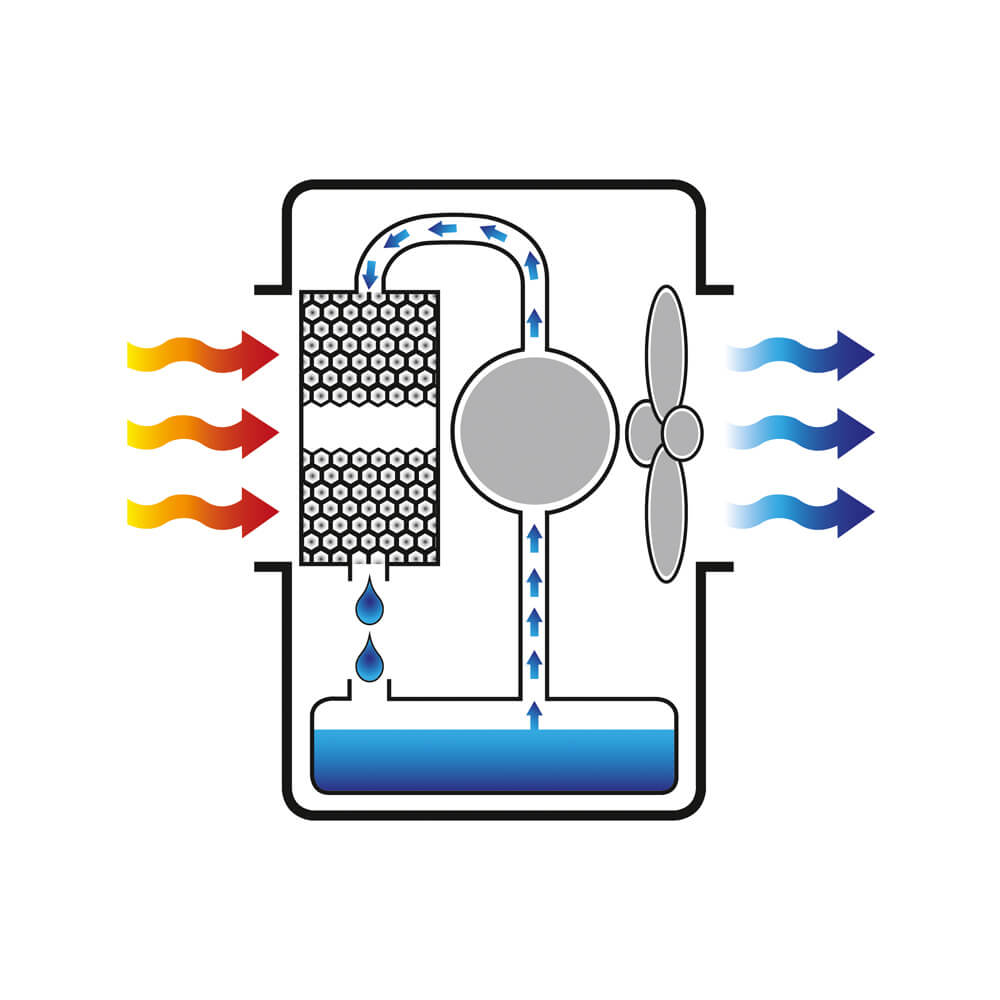
In concrete terms, an adiabatic cooler works as follows:
- Suction of warm ambient air using a powerful fan;
- The air then passes through a humidified media;
- The water contained in the media evaporates on contact with the hot air, absorbing a significant amount of heat in the process;
- The expelled air is cooled by 4 to 10°C, depending on the initial humidity and temperature conditions.
This process requires no refrigerant (as in conventional air conditioners), consumes little energy and offers excellent energy efficiency for cooling large volumes, typically farm buildings.
Humidity control: an advantage in agricultural environments
Unlike traditional air conditioning, which dries out the air, adiabatic coolers help maintain a stable humidity level, which is particularly beneficial for :
- Greenhouses, where controlled humidity promotes plant growth;
- Storage areas to prevent crops from drying out;
- Livestock buildings, where humid air reduces suspended dust and improves animal breathing.
High-performance technology, even in open environments
Another key advantage of adiabatic air coolers is their ability to operate efficiently in semi-open or high air change environments. This makes them particularly suitable for agricultural sheds, partially open livestock buildings or ventilated greenhouses.
Fan, mister or cooler: which to choose?
| Solution | Cooling | Humidification | Water consumption | Ideal application |
| Fan | No | No | No | Air circulation without cooling |
| Mister | Yes | Yes | High | Localized cooling |
| Air cooler | Yes | Yes | Moderate | Large-volume cooling |
How to choose the right agricultural air cooler?
Flow rate, surface area, humidity: technical criteria not to be overlooked
The power of the airflow is a key factor. At OberA, models range from 12,000 to 30,000 m³/h, effectively covering from 150 to over 400 m². It’s also important to consider the desired humidity level and frequency of use.
Ease of use and adaptability to specific agricultural needs
Mobile coolers are recommended for operations where requirements vary from building to building. Their mobility allows great flexibility, without the need for heavy installation. For fixed, high-traffic areas such as large greenhouses or sheds, ceiling-mounted models guarantee uniform, continuous coverage.
Intelligent compatibility with your existing systems
OberA models can be coupled with nozzles, misting accessories or integrated with automatic systems. This makes it possible to adjust the system for heat peaks or critical periods, without over-consumption of water.
The OberA range: your trusted ally for a controlled farming environment
Solutions designed for the demands of the field
The IC range offered by OberA has been designed to meet the most demanding agricultural conditions: robust materials, high flow capacity, low water consumption and simplified maintenance.
What sets OberA apart: fast delivery, installation by our specialized teams, and above all personalized support. We are air treatment specialists and fully understand the needs of manufacturers. We also offer a rental service and test our equipment to validate the most optimal solution.
Solutions for every farm building
Each operation has its own specific features. OberA offers models perfectly suited to :
- Horticultural greenhouses: maintaining even, gentle humidity for sensitive plants;
- Agricultural sheds: rapid cooling of large volumes to protect men and machines;
Livestock buildings: quiet operation, water savings, durability in dusty environments.
