Sommaire
The adiabatic cooler contributes to air filtration
Although this is not its primary function (unlike industrial purifiers), the adiabatic cooler does contribute to the filtration of the air it draws in. This is achieved in two ways: firstly, via the media that filters the dust from the outside air as it enters the cooler, and secondly, via the evaporative media that “washes” the air.
The adiabatic cooler contributes to air purification
The fan ensures air renewal every 3 to 5 minutes, depending on the desired evaporation rate. The continuous renewal of the air in the room helps to clean the air breathed by employees. The evaporative media humidify the air, helping to reduce the presence of indoor air particles. In fact, the adiabatic cooler helps reduce odor nuisance, and shortens the time bacteria, viruses and particles remain in the air. As a result, it helps reduce health risks for workers (respiratory tract irritation, allergies).
What’s more, since the fan doesn’t project droplets through the evaporative panel, the blown air is not conducive to pathogenic organisms and their contamination strategies. What’s more, the evaporative panel receives an anti-fungal and anti-bacterial treatment to prevent the spread of pathogens. Finally, the constant circulation of water, and its temperature below 25°, do not favor microbial or fungal development. Particularly under these conditions, the development of Legionnaires’ disease is prevented. Finally, it is also possible to deploy a UV lamp on the water circuit to kill potential pathogenic organisms.
The adiabatic cooler induces a suitable temperature drop
Adiabatic cooling offers an average temperature drop of 7°C between outside air and room air. This is easily managed by the human body’s thermal receptors. The coolness of the air flow does not generate a sudden temperature differential likely to weaken the human body’s immune defenses, and lead to pathologies.
Moreover, the hotter and drier the air, the greater the drop in temperature. When the external temperature reaches 35°C, a temperature differential of 10°C is reached in the cooled volume.
However, since adiabatic cooling is a bioclimatic technology, it is not suitable if, whatever the weather conditions outside, the set-point temperature has to be strictly below 25°C.
The adiabatic cooler generates regulated humidity
Evaporative cooling naturally humidifies the ambient air. This humidity, created by evaporation, is released from the room through ventilation, producing a constant renewal of indoor air. So, contrary to popular belief, air cooling does not create a clammy atmosphere due to excessive humidity. Residual humidity conforms to accepted comfort standards.
The evaporative cooler also combats low humidity levels in the ambient air, which irritate the respiratory tract and dry out the eyes. Humidity is regulated by modulating air and water flow rates according to room temperature and humidity.
The drier the air, the more likely it is that electrostatic discharge will cause problems such as damage to equipment and loss of production. Generally speaking, when the air contains more than 50 or 60% relative humidity, the risks associated with static electricity become minimal or non-existent. The evaporative cooler is a simple solution to avoid this risk, since it humidifies the air. Particularly in hot, dry weather, in an area where equipment is generating heat, it raises relative humidity above 40%, thus preventing the build-up of electrostatic charges.
What’s more, the humidity provided by the evaporative cooler helps to reduce aerosols, thus contributing to improved air quality. The corollary is reduced health risks for employees and equipment malfunctions.
However, the bioclimatic cooler is less effective in very humid climatic conditions. For example, following a violent summer thunderstorm. In this case, simply stop the water cycle and use the cooler’s ventilation to cool the room, taking advantage of the cooling of the outside air due to this climatic event.
It should also be noted that bioclimatic coolers are not suitable for areas where a very strict humidity specification must be applied, as the humidity level they produce internally depends on the humidity of the external atmosphere. In general, however, the humidification system for this type of zone has already been decided on at the design stage.
The adiabatic cooler creates a comfortable atmosphere in hot weather
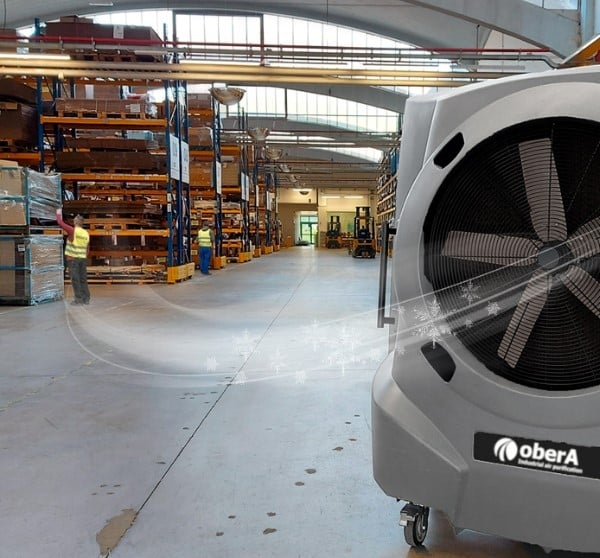
Evaporative cooling provides a comfortable working environment in hot weather. This is achieved by supplying air that is constantly renewed, filtered and cooled naturally and progressively, with the right humidity.
In this sense, adiabatic cooling avoids the loss of staff productivity associated with excessive heat (at 27°C productivity falls by 5%, and at 31.5°C by 10%, according to Berkeley Lab: Indoor Air Quality Scientific Findings Resource Bank).
When external temperatures exceed 35°C, evaporative cooling is the only system that continues to maintain sufficient comfort conditions for the worker. It can still diffuse a cooling breeze while ensuring a comfortable working environment.
