Do you use chemicals in your business, with or without chlorine? Solutions for treating solvents reduce toxic and explosion risks. Paints, cleaning products, solvents are present in many chemical products and are classified as hazardous waste.
Industrial vacuum systems can capture these toxic substances to control air quality and guarantee safety. Among the solutions for treating solvents, some are available in source and ambient extraction. These are based on theadsorption principleand activated carbon filters.

Sommaire
Solvent treatment solution: adsorption
The use of solvents in production activities raises a number of safety issues (health, explosion). However, the management of solvent vapor recovery is now perfectly mastered.
There are 3 solutions for treating solvents :
- elimination solution using activated carbon filters ;
- cleaning with chemical compounds;
- recovery by organic agents.
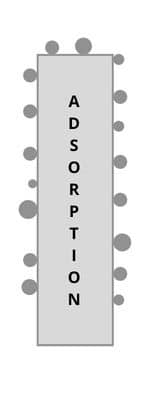
The elimination of solvents via activated carbon filters is a widespread industrial solution. The carbon filter is a molecule trap: when solvents attach themselves to the pores of the carbon, they condense and are eventually recovered.
Solvent processing equipment and systems
Solvent treatment solutions using activated carbon filters are recovery processes. They enable manufacturers to comply with the VLEP while eliminating the most dangerous products (BTEX and CMR). Thanks to technological development and innovation, mobile or stationary air treatment equipment guarantees the safety of various professional activities. Solvents are captured, then evacuated during filter changes.
Solvent treatment solutions at source

Industrial odor eliminators are one of the solutions for treating solvents at source. These small, mobile devices are fitted with suction arms or extraction hoods. They capture the solvent-containing air through the arm or hood, then discharge the solvent-free air through the bottom of the unit. Some ATEX models can be positioned in ATEX zones.
They offer one or two stages of final solvent filtration, downstream of the other filters (coarse, fine and absolute).
Carbon filters are saturation filters (known as molecular filtration), which need to be changed regularly when the pressure drop exceeds a certain threshold.
Solutions for treating solvents in the environment

Air purifiers and industrial odor eliminators are solutions for treating solvents in the workplace without releasing chemical fumes into the environment.
The use of odor destroyers on solvent emissions in the workplace produces excellent results. As proof, many manufacturers of composites, resins, metals, plastics and chemicals use these devices in addition to solvent treatment at source.
Air purifiers (stationary or on wheels) guarantee the regeneration of indoor air. Positioned at the heart of solvent-generating activities, they draw in air, capturing and fixing solvents on activated carbon filters.
Read also: What are the solutions for dealing with dust and solvents at the same time?
Carbon filters: the ultimate filtration stage
In a solvent treatment system, the carbon filter is the last link in the chain. Upstream, other filters ensure its protection (pre-filters, fine filters, absolute filters). Activated carbon is a material that enables all types of solvents to be permanently eliminated from a working environment:
- benzene, toluene ;
- alkanes, alkenes ;
- methanol, ethanol, glycols ;
- acetone, methyl ethyl ketone ;
- acetates, agrosolvents ;
- ethyl ether ;
- chlorine, bromine ;
- amines, amides, terpenes.

Solvent treatment solutions: protect your business
Air treatment without piping or assembly is possible. By installing air treatment systems of this type, you also guarantee the elimination of dust, viruses and bacteria from the working environment. Halogenated and non-halogenated (chlorine-free) solvents are toxic products.
The management of solvent fumes (classified as hazardous waste) is the employer’s responsibility. You can’t eliminate them from your activity? The above solutions are collective protective measures that meet the requirements for preventing the risks associated with the use of solvents.
