Sommaire
Our solutions to reduce your energy consumption
The cost of energy (electricity and gas) is rising sharply. It’s important to manage your company’s energy consumption, especially as winter approaches and temperatures drop. To help you, here are some industry-specific tips you can follow to save electricity in your workshops and offices.
Reducing energy consumption is essential for your company. Not only can you make substantial savings on your energy bills, but you can also control peak power consumption and possible blackouts during cold weather.
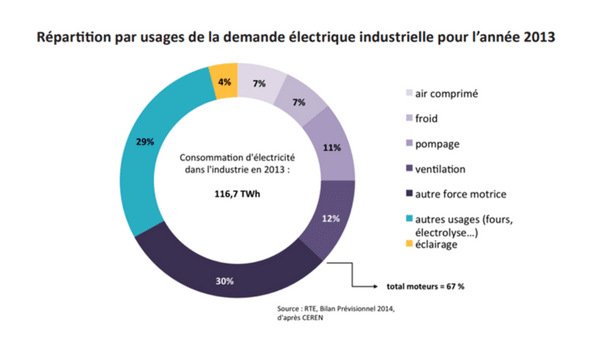
If you exclude from the following analysis the costs linked to the energy required for the manufacturing process (furnaces, ovens, etc.) and for powering production machines, here are the main origins of energy consumption. According to a 2013 study on the breakdown of industrial electrical demand by use, motors account for 2/3 of the industrial sector’s total electricity. Other areas, such as ventilation (12%), pumping (11%), compressed air with machine supply and leakage (7%), refrigeration (7%) and lighting (4%), also account for shares in industrial electrical demand. Of course, these figures should be revised upwards with the development of industrial activity from 2013 to the present day.
Extraction, ventilation and heating of work areas
Vacuuming, dust removal and filtration of machines and workstations
Vacuuming production machines and/or workstations consumes energy. Generally speaking, most electrical energy is consumed by a motorized suction fan. Its role is to draw stale air through a network of pipes and convey it to a dust collector or filter for purification. The fan’s energy is needed to set this air in motion and convey the air flow, thus combating pressure drops in all the components making up the system.
Consider that an efficient medium-pressure motorized suction fan consumes between 10 kW and 15 kW for 10,000 m3/h. This represents an operating cost of 1.5 EUR/h to 3 EUR/h.
Fan power consumption is proportional to air flow rate, network pressure drop and fan efficiency. To limit these consumption levels, here are a few prioritized energy-saving measures:
Reduce or limit suction rates
To reduce or limit suction flow, it is advisable to better encompass and hood the sources of dust emissions. It is advisable to move closer to the sources of pollutant emissions to reduce the flow rates required. Working on simultaneity of operation can also be a solution, so as to extract only what is really necessary. You can also use frequency inverters with flow regulation and automatic hatches to add flow as required. The electrical gain is, at the very least, proportional to the reduction in flow.
Reduce or limit pressure losses in filters and suction networks
The pressure drop generated by a pipe network evolves as the square of the speed. So halving the speed of a network or appliance reduces energy consumption by a factor of four. However, reducing suction speeds is not always possible. Indeed, when vacuuming dust, minimum transport speeds must be guaranteed to avoid deposits. However, this is always possible in downward-flowing vertical ducts.
Improving fan efficiency
To improve fan efficiency, fans and motors with high or very high efficiencies should be used, with optimum fan operating ranges. Frequency inverters can be used to fine-tune operating points.
Ventilation and heating of work areas
The energy consumption of HVAC systems is linked to two components:
- Energy costs linked to calories produced for heating (heating calories)
- Energy costs related to air transport (fans to combat network and plant pressure drop)
Heating energy is often much greater than the energy required to transport the air. In this situation, here are some ways to reduce heating requirements.
Reduce air flows discharged to the outside, necessitating compensation for reheated air
When you discharge 10,000 m3/h outside a building without compensation, the building is depressurized. The flow of 10,000 m3/h is therefore naturally reintroduced through all the building’s airtight spaces. The air enters at the outside temperature and must be reheated to the temperature inside the building. For example, if you heat 10,000 m3/h from 0°C to +20°C, this requires a heating capacity of 50 kW, at a cost of 8 EUR to 20 EUR/h. By reducing the flow of exhaust air to the outside, you can reduce your energy costs.
Separate heating and ventilation functions
By separating these two functions, you can supply only the amount of fresh air required to meet building ventilation regulations (number of m3/h per employee). Air quality in the building can be controlled by an all-recycled industrial air purifier. This saves you the heat generated by the air that was not rejected to the outside, and which would otherwise have had to be compensated for and brought back up to temperature. What’s more, you also save energy by compensating for the pressure drop in the networks used to transport the air. Purifiers generally consume 10 times less energy for the same flow rate. The savings for 10,000 m3/h per hour can be as much as 60 kW.
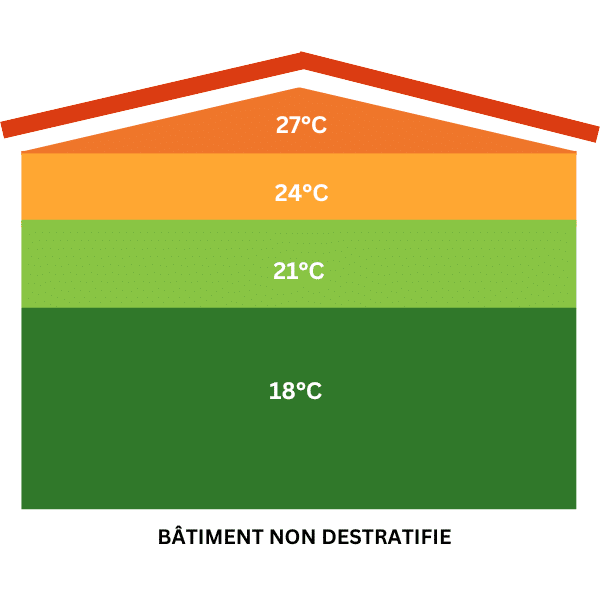
Use destratifying fans or purifiers to destratify layers of warm air
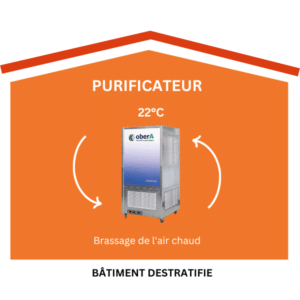
Air purifiers can be used to destratify hot air. Air destratification ensures an even temperature in workspaces. This allows warm air to circulate within the room, limiting heat loss through the roof. This solution can save you up to 30% on heating costs.
Reuse heat from dust collector emissions using double-flow heat exchangers
In this case, it’s important that the exhaust air is particularly clean, so as not to clog the exchanger and rapidly degrade exchange efficiency. The warmer the exhaust air, the more sense this solution makes. The efficiency of this solution can reach 84%, representing savings of up to 40 kW for a flow rate of 10,000 m3/h.
The cold
Adiabatic cooling systems are a natural and economical alternative to industrial air conditioning. Adiabatic cooling solutions are particularly well-suited to cooling high-temperature workshops down to 25°C to 30°C. Adiabatic coolers only require energy to transport the air flow. In fact, they consume up to 10 times less energy than air-conditioning systems, since they use refrigerant-free equipment and do not reject heat to the outside. Cooling energy is drawn solely from the evaporation of water on the evaporative panels.
The heart of the evaporative cooling system is the cooling media where the water evaporates, refreshing the air circulating inside. Evaporative cooling media are made from fluted cellulose sheets. The integrated water distribution system distributes water evenly over the cooling exchangers to ensure that the entire surface is kept moist. This maximizes the cooling effect. Fans create negative pressure, drawing air through the exchangers.