Sommaire
What are the advantages and disadvantages of each OberA product?
ePur
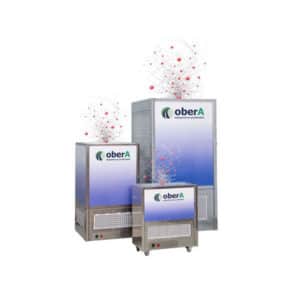
ePUR030 and 100, The two products in the ePUR range are powerful devices capable of treating areas ranging from 400 to 700 m². Their airflow is adjustable, allowing the treatment power and noise level to be adapted to the constraints of the room to be treated. Their respective weights are 42 and 230 kg. The casters allow the devices to be easily moved from one room to another or for cleaning operations. Thanks to its plug & play design, simply plug it in and it’s ready to go. The ePUR range is very economical and consumes less than a domestic vacuum cleaner.
virbox
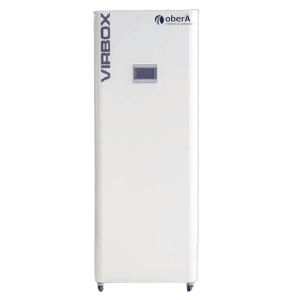
VirBox 750 is a perfectly designed device from an aesthetic and technological point of view. Due to its adjustable airflow, its noise level varies between 25 and 48dB. Its airflow of 1300 m3/h allows it to treat areas up to 90m². It is possible to add a CO2 sensor capable of indicating when the room needs to be aired. The device is also customizable and can be tailored to your taste (company logo, school decorations, etc.). Another possible option is the addition of a UV-C lamp for a second virus elimination stage in addition to the HEPA filtration stage. Its casters allow it to be easily moved.
VirBox 1500 is a device with adjustable airflow, and like the VirBox 750, its noise level varies between 25 and 48dB. Its airflow of 3500 m3/h allows it to treat areas up to 200m².
EPUR05
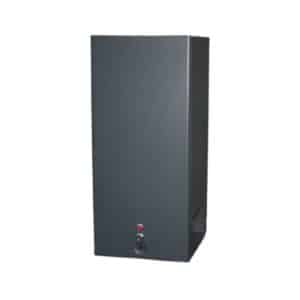
ePUR05 features a soundproof design, making it one of the quietest devices in the anti-COVID range, with only 47 dB. Like the Ecoprime, the ePUR05 is easily transportable to be placed as needed. Its suction power allows it to treat workspaces up to 60m².
ecoprime
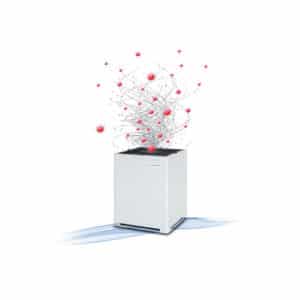
The Ecoprime is a perfect device for small areas up to 20m², such as offices, waiting rooms, or small classrooms. However, beyond that, the device will no longer be suitable for larger areas. Its weight and dimensions make the Ecoprime a mobile device, easily movable as needed. Particularly quiet and with adjustable airflow, it can be placed in any type of room, even quiet ones, without being noticed.
Comparison in terms of price per square meter treated or per cubic meter of air treated
To effectively reduce the risk of infection by virus-infected aerosols, it is necessary to regularly replace the ambient air. The air change rate indicates how often the air in the room is treated per hour.
A minimum air change rate of 3 to 5 times per hour should be observed.
The air change rate achieved by an air purifier primarily depends on its power (treated airflow during operation, not idle!) and the size of the room in which it is placed.
For example: the ePUR 030 air purifier provides an airflow of 3,500 m³/h. Up to a space volume of 875 m³ (e.g., 350 m² surface area at 2.5 m height), it thus ensures 4 air changes per hour. With a volume of 350 m³ (140 m² surface area at 2.5 m height), 10 air changes per hour are achieved. Its price per square meter treated is between €5 and €16.
- Ecoprime is capable of treating areas up to 20m². The price per square meter treated is between €12 and €35.
- ePUR05 treats areas up to 60 m², which corresponds to a price between €10 and €32 per square meter treated.
- VirBox 750 has a suction power capable of treating areas up to 90m². This gives it a price per square meter treated between €10 and €30.
- VirBox 1500, more powerful than the 700, is capable of treating up to 200m² of workspace. This capacity is equivalent to a price per square meter treated between €7 and €19.
- ePur100, the most powerful in the anti-virus purifier range, is capable of treating up to 700m² of surface area. The price per square meter is therefore between €5 and €15.
Which anti-virus air purifier should a professional choose?
if I am an industrial professional
In an industrial environment, the choice of an anti-COVID air purifier will depend on its ability to also treat other pollutants. Indeed, industrial professionals face numerous pollutants, which is why it is important to choose an anti-COVID air purifier capable of treating these other pollutants with multiple filtration stages and thus adequate power. This choice of a versatile air purifier for filtration will not only protect people exposed to pollutants but also, and above all, protect the high-efficiency filters used to treat viruses and bacteria.
if I am a school, a museum, or a library?
For a school, a museum, a library, or even offices, the choice of an anti-virus air purifier will often be based on the device’s noise level. For these locations, it is necessary to combine treatment power (in m3/h) and low noise level to ensure maximum efficiency without causing any auditory discomfort.
Generally, a powerful device will be preferred, which can be operated very quietly at half its nominal flow rate, with the possibility of temporarily increasing the flow rate at the end of the day or during breaks.
if I am a public access building (ERP)?
For theaters, concert halls, or any other large public spaces, it is essential to rely on the device’s power to ensure 4 to 6 air changes per hour as recommended by INRS and the High Council for Public Health.
For premises not equipped with mechanical ventilation, the HCSP recommends:
- Opening windows several times a day and in the absence of human presence other than cleaning staff (before staff arrival, during lunch break, and in the evening during cleaning operations, 15 minutes each time).
- Avoiding the use of premises that cannot be aired by opening a window or installing an air purifier equipped with HEPA H13 or H14 filters. This device must operate 24/7.
- Keep doors closed.
For premises equipped with mechanical ventilation operating in “all fresh air” single or double flow, it is advisable to:
- Ensure there is no risk of contamination from one room to another (this is generally the case, but it should be checked by technicians in charge of air treatment system maintenance).
- Open windows and ventilate several times a day and in the absence of human presence other than cleaning staff.
- Increase the fresh air flow if opening windows is not possible.
- If the room is under positive pressure, place it under “zero pressure” if possible.
- Keep doors closed
For premises equipped with mechanical ventilation (air handling unit) operating with partial recirculation, it is recommended to:
- Increase the fresh air rate as much as possible and if this does not lead to a significant increase in the total supply airflow.
- If the recirculated air is not filtered (HEPA filtration), maintain the outdoor fresh air supply and, if possible, stop recirculation.
- If the room is under positive pressure, place it under “zero pressure” if possible.
- Keep doors closed.
For premises equipped with mechanical ventilation operating with total recirculation (e.g., individual air conditioning – split unit, fan coil unit)
- Open windows several times a day and in the absence of human presence other than cleaning staff.
- Turn off the device if possible. Otherwise (e.g., heatwave), set the ventilation to minimum and direct the airflow towards the ceiling if the units are installed high up. Avoid placing people in the airflow. In the case of fan coil units installed on a low wall (lower part), it will be necessary to keep a distance (more than 2 meters) from the device, its ventilation power will be set to minimum, and the airflow directed towards the ceiling if possible. This distance can be reduced if a person occupies the room alone without external visitors. In this case, the door must be kept closed, and meetings with other people should take place outside the room.
- Keep doors closed.
