In addition to the strong ecological impact we often hear about in the media, air pollution is very harmful to our health.
Indeed, according to a study led by Dr Rob Beelen (University of Utrecht, Netherlands), published in the medical journal The Lancet in 2013, a 5 microgram per cubic meter increase in PM2.5 concentration increases mortality by 7%.
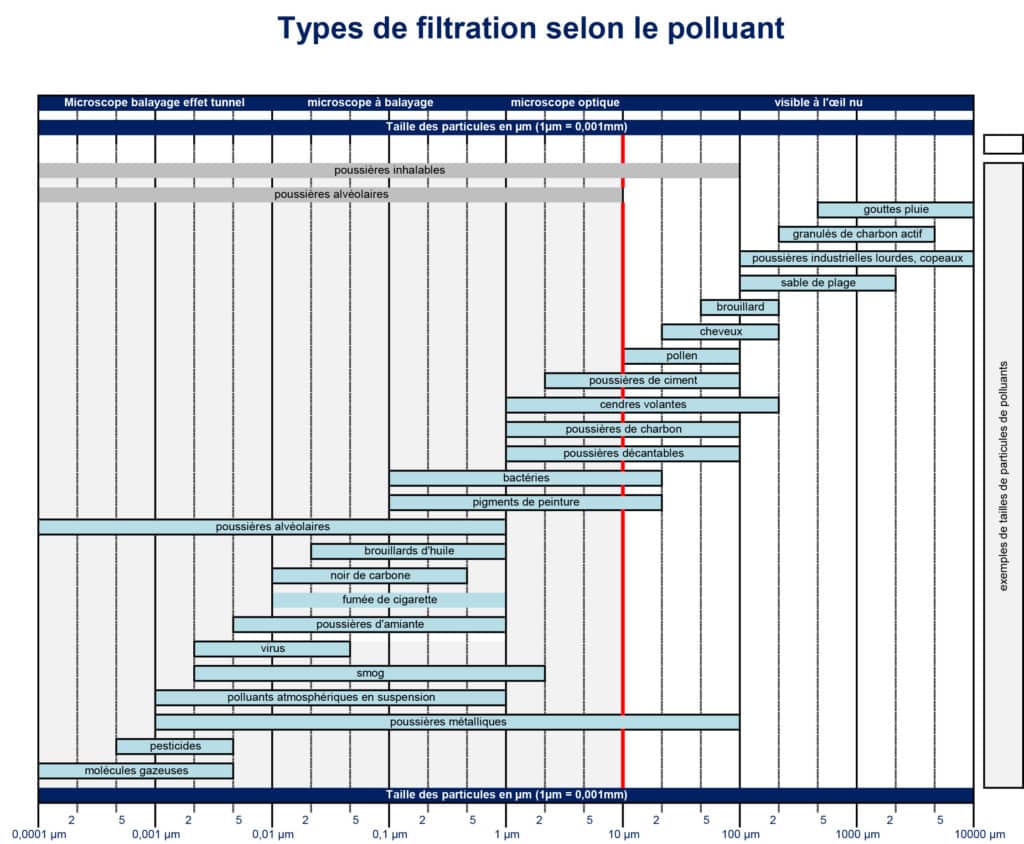
Diameter of pollutants
The table above gives an indicative list of the average size of various pollutants. The coarser the particle, the more the body will be able to fight it off; conversely, the finer the particle, the greater the risks.
We need to distinguish between two types of particles. Those with a diameter greater than 10µm are visible to the naked eye, especially on sunny days, and particles smaller than PM 10 are invisible to the eye. These make up the bulk of the dust and are also the most dangerous. What’s more, as their mass is very low, they are subject to air flow and disperse very easily. All aerosols fall into this category.
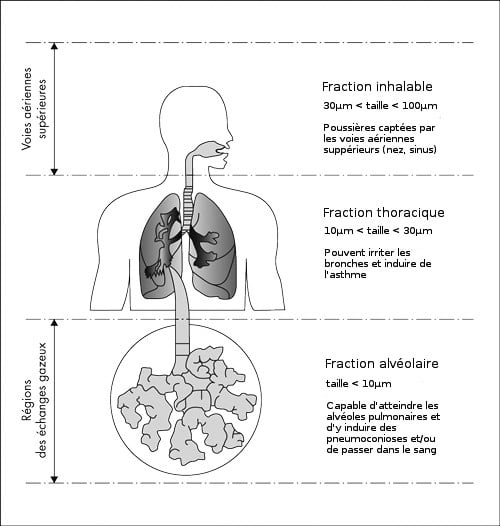
Dust granulometry and its effects
The diagram above shows the level of penetration of particles into the body as a function of their diameter. The finer they are, the deeper they become lodged in the body and the harder they are to excrete.
Naturally, the body can expectorate dust thanks to its pulmonary cilia. These will push the particle higher and higher into the digestive tract, eliminating it through digestion. But some populations are more vulnerable. As a result, smokers see their lung cilia diminish considerably and will therefore take longer to excrete them. Asthmatics are more sensitive to air pollution…
One of the most prevalent factors in particle toxicity is biopersistence: the time it takes for the body to expel the dust.
Another factor is PM 1. These particles are so fine that they pass through the pulmonary alveoli and migrate directly into the bloodstream. These include cigarette smoke, viruses and pesticides…
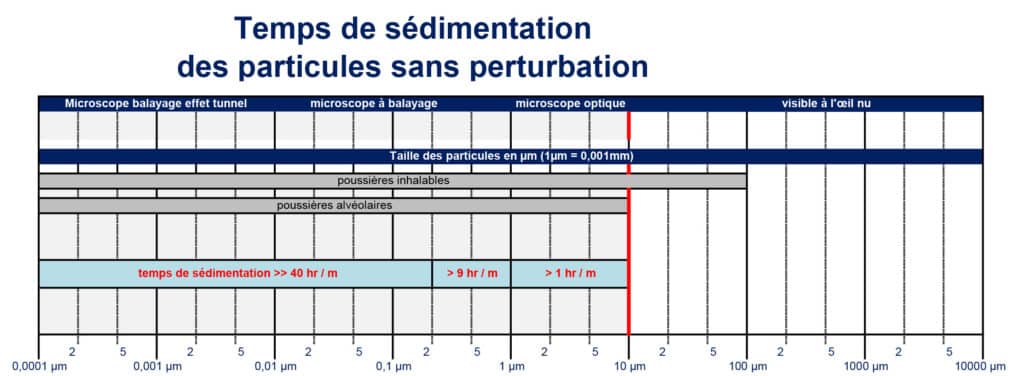
Sedimentation time
All particles precipitate. But in the case of ultrafine particles, it can take several days before they settle to the ground.
The mass and density of the dust determine its sedimentation speed. The smaller the mass, the longer it will take to precipitate and the more sensitive it will be to air flows.
So, theoretically, if we wanted to wait for all the dust to settle, we’d have to completely shut down the company for 15 days. As this is almost never the case, the finest particles always remain in suspension and concentrate.
Find out what dust and solvents are in industry by reading our dedicated article, as well as the complete guide to industrial air treatment.
