Dust, smoke, fine particles, chemical odors… Industrial processes generate numerous compounds that pollute your working environment. However, air quality control is essential in industry to protect the health of your employees and the operation of your facilities. The solution: invest in an industrial air treatment system. Dehumidifiers, ventilation systems, air purifiers, heating and air conditioning equipment, air handling units, industrial dust removal, smoke extraction, odor eliminators, particle filters… To help you make sense of the equipment jungle, we explain why and how to treat the air in your industrial building.
In an industrial environment, controlling air quality is essential to a company’s health and productivity. It’s a complex subject that requires careful study before investing in a safe and efficient air handling system.
Sommaire
How do I treat the air in my workshop?
Two main families of solutions can be envisaged.
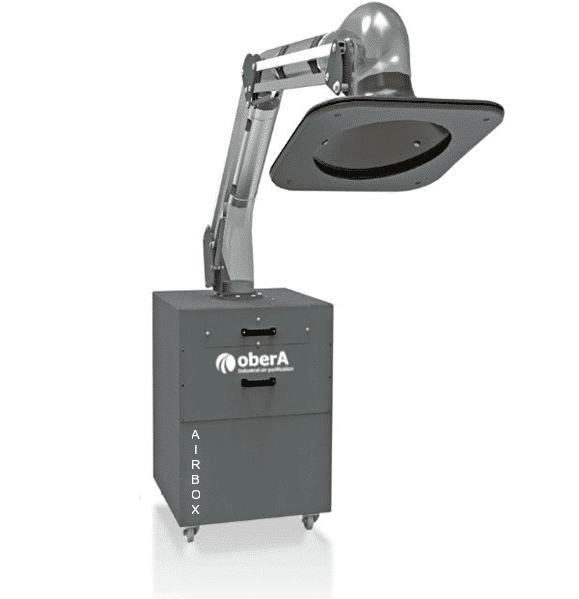
Source capture: this involves capturing pollutants as close as possible to the source generating them, to prevent them from spreading into the air. This can be done using a number of capture accessories: a suction arm, an extraction hood, a hood, a suction backsplash, a Pouyes ring, a suction booth, a suction wall, a suction plenum or even a suction table when a workstation is to be treated. When the source comes from a production machine, it can be connected directly to the air handling unit via a network of ducts or pipes.
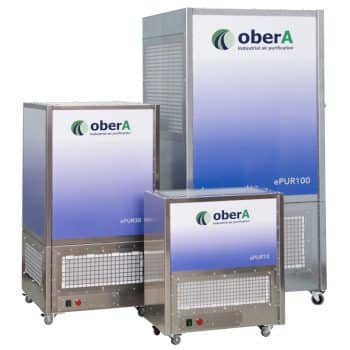
Ambient treatment involves capturing ambient pollutants present in the air of your workspace. This method is generally used when the pollutant source is unknown, diffuse or inaccessible. The devices used are air handling units or industrial air purifiers.
For source capture, sufficient air velocity must be induced. With sufficient air flow, the initial trajectory of polluted air will be altered and forced to flow through your vacuum system. The formula for calculating the required flow rate is as follows:
- Q= A Ve
- Q: suction flow (m3/s)
- A: total area of openings (m²)
- Ve: velocity of air entering through openings towards the interior (m/s)
Once the capture method has been defined, the principle remains the same. Polluted air is drawn into an industrial air handler and passed through several stages of filtration before being discharged outside or directly back into the workspace.
Why treat the air in my workshop?
Industrial air treatment is essential for controlling building air quality parameters:
- Dust and pollutant concentrations through treatment and/or renewal.
- Temperature through heating, air conditioning and/or cooling.
- Hygrometry by drying or humidifying the air.
What’s more, this will enable you to comply with the law (maximum concentrations of pollutants breathed in by operators at their workstations). VLEP (Valeurs Limites d’Expositions Professionnels – Occupational Exposure Limit Values) are a dust threshold not to be exceeded at a workstation. It is considered that only exposure to higher concentrations or over a longer period of time will have health consequences. Air treatment will enable you to stay below regulatory thresholds. If your industry does not meet the threshold for a chemical agent classified as CMR category 1A or 1B, the workstation must be shut down until measures to protect employees have been implemented. (VLEP)
You will ensure the health and safety of your employees. This will lead to a reduction in sick leave and avoid a drop in productivity. In addition to dangerous dust, a good number of viruses and bacteria are airborne. Filtering the air considerably reduces the risk of spreading disease.
Lower cleaning and heating costs. In fact, an air treatment unit will reduce the level of dust that usually settles on your floors, machines and goods. If the unit re-injects the treated air directly into your workspace, the calories will be recovered.
Fewer breakdowns mechanical appliances and electronic instrumentation need clean air to function properly. Dust can enter equipment and cause malfunctions. Most machines are equipped with particle filters to prevent such inconveniences. Unfortunately, they have to be replaced regularly, and the finest particles still pass through the filters. That’s why we recommend purifying the ambient air to reduce the frequency of machine breakdowns and malfunctions.
Producing quality. Indeed, certain manufacturing processes require controlled air quality in terms of particle numbers (cleanliness) and, if necessary, temperature and humidity. This is the case for cleanrooms and gray rooms, where these parameters are continuously monitored to guarantee a sterile room with a controlled atmosphere. Here, the particles treated are microscopic, invisible to the naked eye.
Also read: Measuring indoor air quality: interest and principle.
What are the different sources of pollution?
There are many sources of pollution, but the three largest and most recurrent are the following:
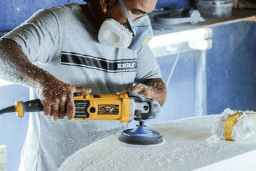
Pollutants from processes. Whether working with wood, metal, plastic, etc., processes such as deburring, milling or sanding produce large quantities of pollutants.
Outside air, brought in by wind and draughts, door openings and pressure differences between buildings, accumulates in your building.

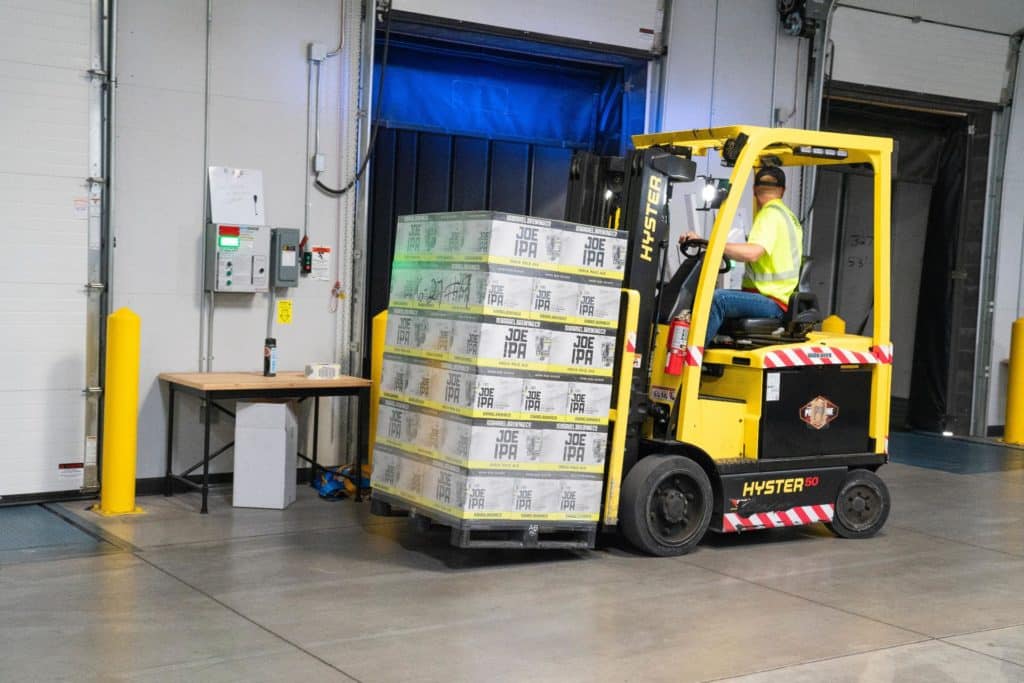
Dust generated by forklift movements, for example, or by truck or forklift exhaust fumes, tire wear, gasoline or gas vapors, etc…
What filtration equipment should I use?
There are several types of air handling unit, depending on budget, power, options, etc…
Industrial dedusting and extraction
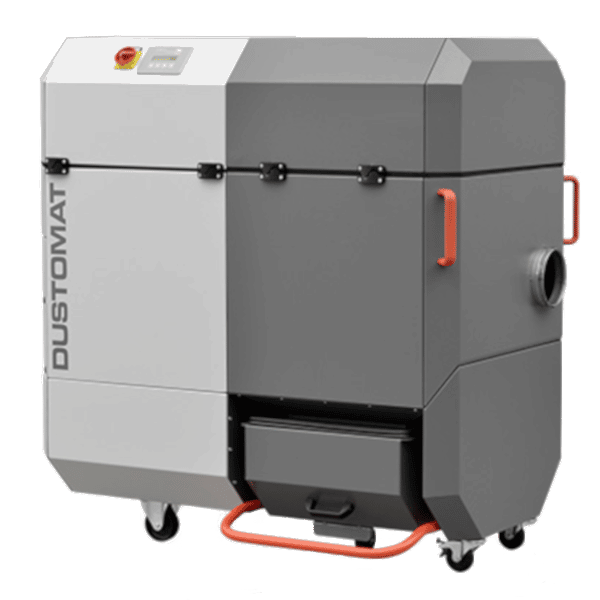
A suction and dedusting system is generally taken to mean a system comprising a collection network (piping and source collection devices), a deduster (filter with a regenerable filter medium such as cartridges, bags, pockets, etc., which can be cleaned mechanically or by a manual or pneumatic cleaning device), a motorized suction fan or suction turbine and a discharge pipe for the clean filtered air (chimney or drain, etc.).
In this family we distinguish :
- Industrial bag filters and dust collectors are among the equipment capable of delivering the best dust filtration results. The dust collector is fitted with handles, either stretched or on a metal structure (basket). They are designed to separate particles on the surface of the filter media
- Industrial cartridge filters and dust collectors, which filter fine dust and fumes from the surface of the cartridge to produce clean air.
- Industrial bag filters and dust collectors, ideal for trapping metal, wood, composite, powder and other dry dusts.
- Wet dust collectors, used to extract incandescent or greasy dusts, or those presenting an explosion and/or ignition hazard.
- L’aspiration et le dépoussiérage basse pression et haute pression : on appelle généralement haute pression, une installation dont le débit est faible et les pression élevées (env. 0 à 1000m3/h et une très forte dépression (-30.000Pa à -3000 Pa et une tuyauterie de faible diamètre (Ø25, Ø28, Ø50, Ø73, Ø80, Ø100)
- A low-pressure suction system is a dust collection and filtration system with a flow rate of between 0 and 100,000 m3/h, a pressure of between -5000 and -2000 Pa and a pipe diameter of Ø100 to Ø1000 or more.
- Les différents types de dépoussiéreurs :
- Fixed or mobile.
- Rectangular: Best filtration quality/energy consumption ratio, offers a multitude of customization options. Or Cyclonic: Removes coarse particles by cyclonic effect before filtering out finer particles.
- Under pressure: the fan pushes polluted air into the filter. Or vacuum: the fan draws polluted air through the filter.
- Explosive atmospheres. In industrial dust collection, some dusts are classified as explosive, which is why three ATEX zones have been created for explosive dusts (20-21-22) and three others for explosive gases/vapors (O-1-2), in order to understand which equipment and which filter types to use depending on the ATEX zone.
Gaseous or flue gas treatment
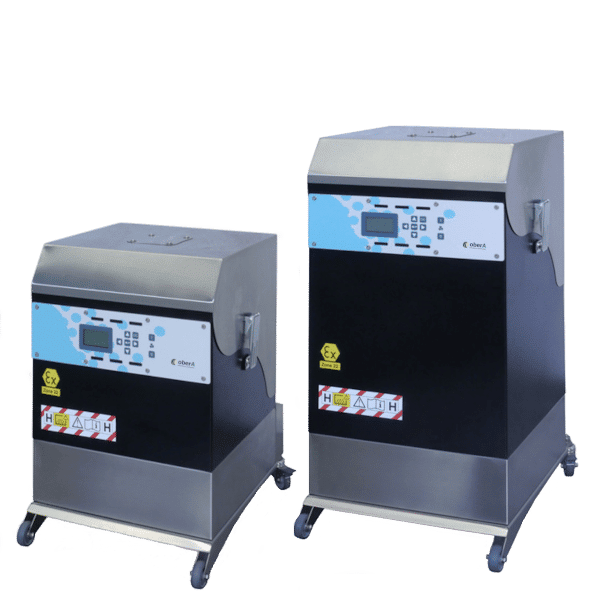
Dust filtration is generally combined with physical-chemical treatment and/or molecular filtration (adsorption on activated carbon) in the form of pellets or powder injected into the process.
Air handling units
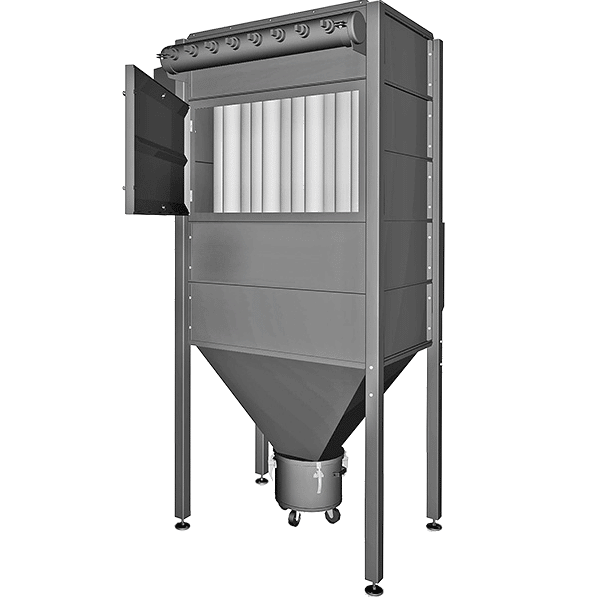
It consists of several consecutive treatment stages that may or may not be associated with :
- Pre-filtration (G3 to F9)
- Main filtration (F7 to HEPA14)
- Molecular filtration (activated carbon)
- A hot/cold heat exchanger
- A humidifier
They are used to equip several workstations. When there’s not enough space in the workshop, this system can be located outside the building and treat the air via a network of ducts and pipes.
Industrial air purifiers

These are mobile suction units generally used for ambient treatment of dust, fumes and odors present in the air of your workspace. Two types of filter are available for these air purifiers. Saturation filters, which have to be replaced once full. This is followed by unclogging filters which, once saturated, are cleaned automatically by compressed air or by a manual unclogging system (brush or shaker).
To measure the efficiency of an air purifier, we use the concept of CADR ( Clean Air Delivery Rate ). In simple terms, this is the flow rate of the unit multiplied by the particle separation efficiency. For example, 10,000 m3/h (actual unit flow x 85% fine particle separation rate = CADR of 8500. The 3 pollutants on which this standard is based are those most commonly found: pollen, smoke and dust. The higher the CADR, the better the purifier.
Industrial air purifiers, generally used for ambient capture to treat dust, fumes and odors in the air of your workspace.
Industrial dust collectors, more often used for source extraction in processes generating much coarser and more dangerous dusts.
Air handling units, used to treat a volume of air.
Industrial ventilation, used to expel polluted air from the premises. The air is therefore not treated, but replaced by fresh air from outside.
What filters exist?
Air treatment certainly requires a good unit, but the filters chosen to accompany it are just as important. First of all, it’s important to know that the chemical nature of particles is not their only harmful factor. The finer the particles, the easier it is for them to penetrate the respiratory tract and reach the pulmonary alveoli. The health risk is therefore high. Several types of filter exist.
Pre-filters
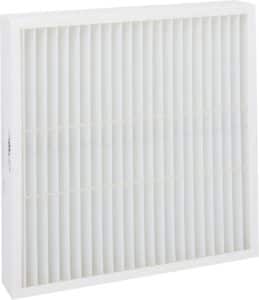
They are the first stage of filtration and can have several roles. Most of the time, these pre-filters act as pre-separators. They help to “sort out” fine and coarse particles. Its purpose is to capture coarse particles in order to protect subsequent filters, which are generally more expensive and dedicated to finer particles.
Pre-filters can also be used, this time to sort out grease or sparks to prevent damage or fire to the air-handling unit.
Fine filters (M5, M6, F7, F8 and F9)
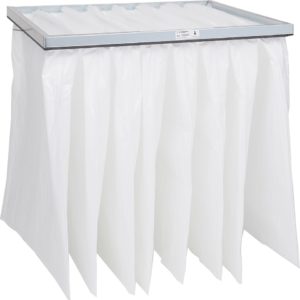
They are used for high-efficiency filtration. In fact, they can treat 99.9% of pollutants larger than 0.1µm, such as spores, bacteria and smoke. They can also be used as a pre-filter for absolute filtration. (Very high efficiency).
Absolute filters (H13, H14 and U15)
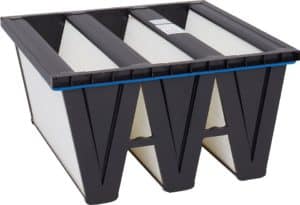
These are very high-efficiency filters. HEPA filters, capable of filtering at least 99.995% of particles greater than or equal to 0.1µm. Or ULPA filters, even more precise, capable of filtering at least 99.9995% of particles greater than or equal to 0.1µm. Their use is required for the treatment of noxious dusts or where there is a requirement for sterilization or cleanliness, such as in clean rooms, operating theatres or analysis laboratories. They are always used as a terminal filter. These filters are saturated and need to be replaced each time they become saturated.
Activated carbon filters
They are also often used as terminal filters for the treatment of VOCs (Volatile Organic Compounds) and other types of gaseous pollutants.
Charcoal is highly effective against odors and other gases, absorbing and eliminating them.
Particular case of standard EN 60335-2-69 Annex AA which categorizes filter qualities into three classes L, M and H to be used according to the hazardousness of the dust.
This standard was originally developed for floor vacuum cleaners, but is now used to classify filtration qualities on dust collectors. We distinguish three classes:
- Class L – Moderate-risk dusts – the filter stops 99% of dusts with a particle size of less than 2 microns
- Class M – Medium-risk dusts – the filter stops more than 99.99% of dusts with a particle size of less than 2 microns
- Class H – Dusts representing a high CMR risk – the filter stops more than 99.995% of dusts smaller than 1 micron (includes carcinogenic dusts and dusts contaminated with carcinogens and/or pathogens).
Filtration characteristics are guaranteed by tests carried out on the machine and on each of the filters installed. A filter efficiency certificate is issued for each Class H machine.
