Versatile, OberA suction tables are dedicated to industrial processes such as part machining. As a major piece of equipment helping to protect operators andimprove the quality of the working environment, we can help you choose the model best suited to your needs and constraints.

Sommaire
Machining industrial parts: VOCs and industrial solvents
The machining of workpieces is a process that generates a number of pollutants that have a serious impact on operators’ health. These include both coarse dusts (metal dust, plastic dust, wood shavings) and fine dusts, which are particularly toxic to the body.
Other operations, such as cleaning metal surfaces before or after machining parts, also release pollutants: solvents and VOCs (volatile organic compounds). In addition, VOCs can interact with other chemical substances, causing odour nuisance.
For all these reasons, opting for a source capture and pollutant treatment solution makes it possible to :
- Comply with air quality and workplace safety requirements;
- Protect operators.
OberA solutions comparison: the different ranges of suction tables
OberA product comparison
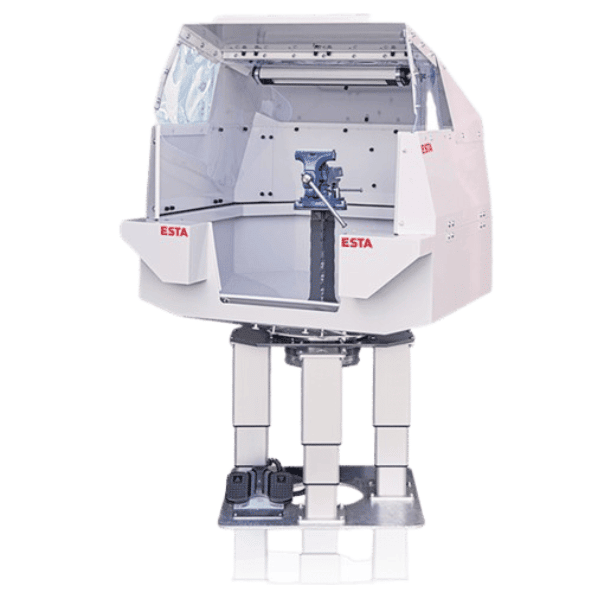


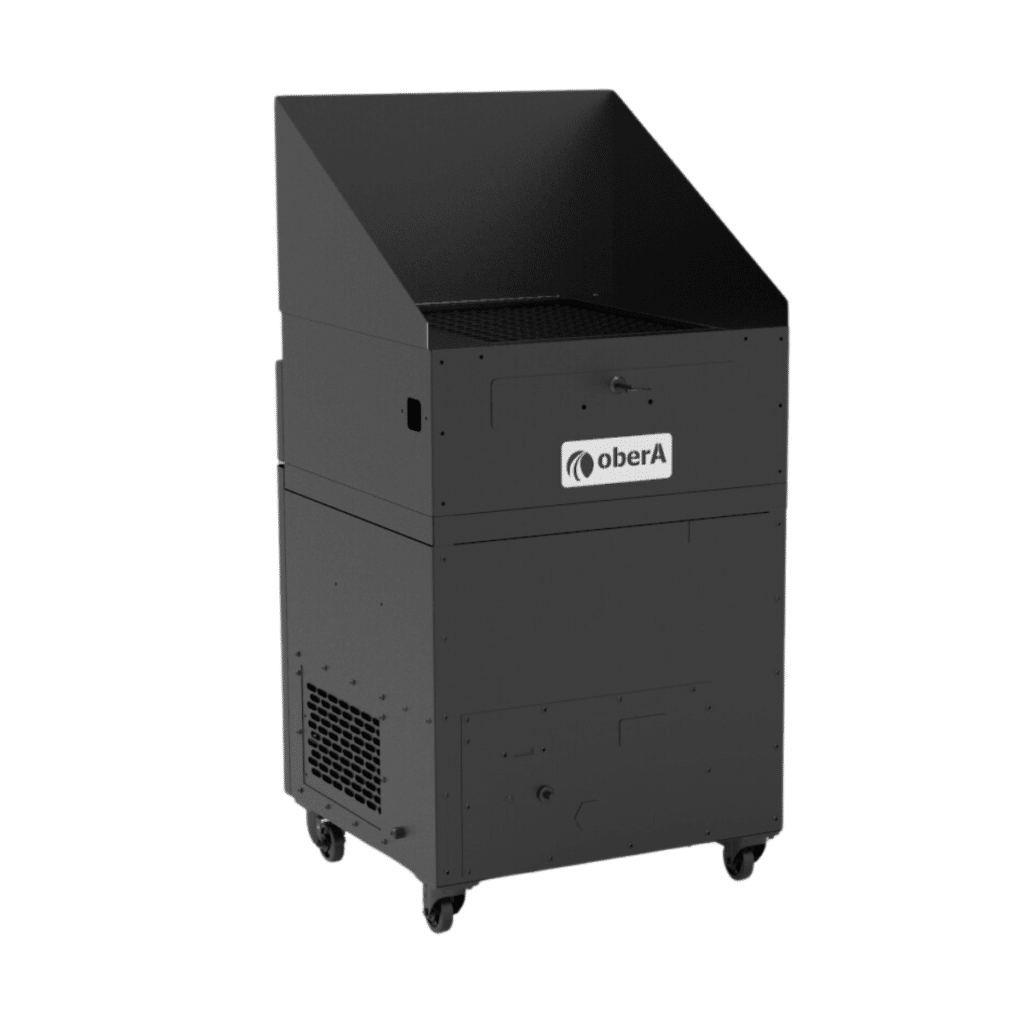
| 360° rotating vacuum table | downdraft table | Self-contained suction table | ePURBOX ATEX table | |
| Type | For connection to a fan or suction system | For connection to a ventilation system or dust collector | Integrated filtration system, automatic filter cleaning function | Integrated filtration and ventilation system |
| Pollutants treated | Heavy pollutants (composite materials, metal dust, plastic chips, concrete dust, etc.) | Coarse dust, fine particles, gases, fumes, oil mist | Dusts, solvents/odors, VOCs, fumes, chips, oil mist | Coarse particles, solvents/odors, fumes, vapors, VOCs |
| Special features | 360° rotation, parts accessible from all sides, adjustable height | Adjustable height, galvanized steel grid, compact and robust product, easy removal of coarse waste. | Spacious work surface, customizable grid, table equipped with spark separator, automatic filter cleaning function or saturation filters. | Compact and mobile product, very high efficiency fan, simplified filter media replacement, silent and economical, 2 or 3 filter stages configurable according to pollutants |
| Applications | Machining processes, mechanical and thermal separation processes, milling, brazing, welding | Grinding, welding, painting, adhesive application, gluing, varnishing | Grinding, welding, painting, etc. | All industrial processes |
| Dimensions | Maximum part width 900 mm | Working area from 1000 x 1500mm to 1000 x 2500 mm (depending on model) | Working area from 700 x 680 mm up to L1000 x 2500 mm (depending on model) and beyond | Work surface 570 x 460 mm |
| Options | Lighting, protective cover, ATEX version, grid or vice, magnetic protective jaws | Retractable side cheeks, aspirating backsplash, fold-down lid, lighting, castors, turntable, customizable dimensions | ATEX-compliant, HEPA filtration, fire protection system, silencer, 304/316 stainless steel, resistant paintwork | Suction arm, tubed inlet, tubed outlet |
Vacuum table selection: connectable table or integrated filtration system?
Some vacuum tables need to be connected to a side dust collector or ventilation system, while other models feature an integrated filtration system. Both systems have their advantages and disadvantages, but the most suitable type of table will depend above all on the concentration of pollutants present. If your machining processes generate a high volume of pollutants, then you’ll need to opt for a connected suction table.
Which surface to choose for machining parts?
Depending on the size of your workspace, the vacuum table can take up more or less space. It’s therefore important to choose an equipment footprint that allows your teams to move around freely. In addition, the table surface must be adapted to the size of the workpieces to be machined.
For example, our stand-alone vacuum tables, and our A & AT tables as an option, can be fitted with side panels to allow the machining of large workpieces that protrude beyond the work surface. The ePURBOX TSP, on the other hand, is designed to be compact, so that it can beeasily integrated into small spaces for the machining of smaller workpieces.
Should I opt for a grid vacuum tray?
Grid-type vacuum platens are recommended for machining parts made of non-magnetic materials such as ceramics, plastics, aluminum and glass. They are also recommended for machining parts requiring high precision.
Grid vacuum platens are not recommended for routing, milling or drilling, where the use of a martyr mat is recommended. Don’t hesitate to ask us about the different features of our trays, to ensure that they meetall your industrial processes.
