Sommaire
When do I need a central vacuum system?
This is a question we’re often asked when making contact and analyzing needs. To answer it, we need to take a closer look at the functions and possible uses of a central vacuum system. There are a number of professional vacuum solutions available in the industrial sector. The components are essential for identifying which system is best for your company.
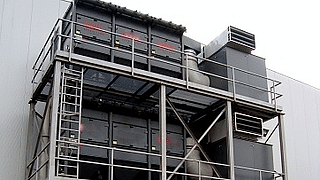
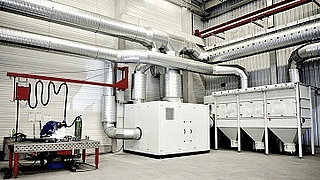
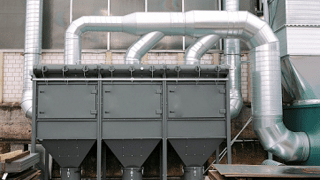
What are the components of a fixed vacuum system or a dust extraction and filtration system?
The optimum selection and design of components for each application, and the best possible harmonization of components with each other, are the key to creatinga high-performance extraction system. When designing a vacuum system, it is important to take into account not only the specific conditions of use, but also current regulations and directives.
As a rule, a vacuum system consists of the following components:
Filtration unit / filter / dust collector
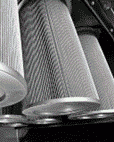
The filter unit is the centerpiece of any vacuum system. The better the filter unit is designed, the better it works, and the better the separation result. The filtered air is purified after the filtration process.
The filter consists of filter media or filter elements mounted in a filter box. Depending on the application, filtration may be dry. In this case, the filter box is fitted with filter elements such as filter bags, filter cartridges, filter bags or even filter cassettes. Filtration can also be wet (scrubber), in which case water is used to agglomerate the dust into micro-droplets.
In the case of dry separation, the filter elements can be cleaned and regenerated (often referred to as unclogging). This guarantees constant suction power and low operating costs. To guarantee effective separation, the number and design of filter elements must be matched to the type of pollutant to be extracted. To avoid premature filter clogging, the filtering speed or filter surface loading rate (flow rate divided by filter surface) must not exceed a defined limit.
Another important factor is the introduction of dust-laden air into the filter box or dust collector. The aim is to feed the filter elements as evenly as possible, while achieving a low air velocity in the filter. In this way, the filter elements can be effectively cleaned even during suction operation.
Discover more with the G4 air filter for low-dust air treatment.
Extraction turbine or fan
The extraction turbine of a suction system ensures the necessary air flow. A distinction is generally made between low-, medium- and high-pressure extraction turbines. For dust extraction systems, medium- and high-pressure extraction turbines are particularly important. Medium-pressure extraction turbines are generally fans used for applications where dust-containing air needs to be captured and extracted. Vacuum ranges up to around 8,000 Pa. for medium to high air flow rates. High-pressure turbines (vacuum pumps) include side-channel compressors and rotary piston or screw compressors. They are used in applications where deposited materials need to be “picked up” and transported in high-strength pipes. They deliver high vacuum (from 14,000 Pa or 140 mbar.) at low air flow rates.
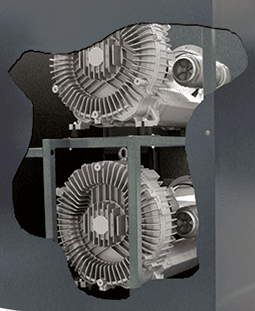
To achieve a satisfactory suction result, it’s essential to select the right extraction turbine and design it to suit the application. Important factors include, for example, the number and simultaneity of suction points, the diameter of the connections to the suction points, the required conveying speed of the material to be extracted, and the length of the suction lines.
The extraction turbine is usually installed next to the filter. In view of the ever-increasing demands for low noise emissions, extraction turbines are installed in acoustic enclosures (soundproof boxes) which reduce operating noise and also act as weather protection for outdoor installations.
Dust removal
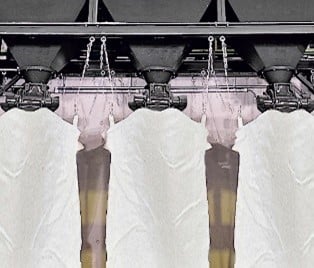
Dust extraction is located in a central extraction system, directly below the filter, and ensures that particles extracted from the air stream are removed from the filter unit. Barrels, drums or collection drawers are often used as standard, connected to the filter unit by a cone. It is important that the volume of the collection containers is matched to the amount of dust produced. If collection containers are too small, emptying is often neglected and separated dirt accumulates in the filter unit, leading to malfunction.
In the case of substances hazardous to health, it is necessary to eliminate them by avoiding contact with operators.
For large volumes of dirt, we recommend the use of automatic evacuation elements such as rotary sluices or evacuation valves or flaps, which continuously evacuate the material from the filter unit. If the dust collector is not equipped with an automatic evacuation system, the dust collection tray can only be emptied when the dust collector is switched off.
Control unit
The control unit, also known as the control panel, regulates all the important functions of the central vacuum system and ensures trouble-free operation. A large number of sensors continuously monitor the system’s most important functions, ensuring virtually fully automatic operation. For example, the suction power can be adapted to actual requirements, depending on the number of collection points to be vacuumed(according to the index explained in the depollunet.net article) or the dust load in the air stream. This reduces operating costs thanks to low electricity and compressed air consumption. It is also possible to determine which maintenance or servicing work needs to be carried out on the basis of performance data, and not just on the basis of defined operating hours as before.
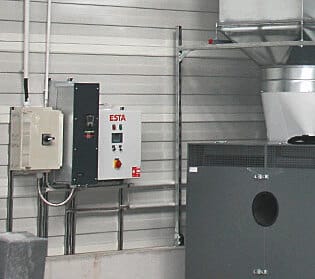
The vacuum system control unit, combined with high-performance sensors and intelligent software, ensures that today (and especially tomorrow) the system operates perfectly in line with the application.
Other components
In the broadest sense, a vacuum system also includes these components:
- Suction pipe
- Pre-separator
- Secondary filter and heat recovery
- Air recirculation/exhaust line
For a vacuum system to work optimally, sustainably and economically, it’s essential that the components are perfectly matched to each other and to the application.
Corresponding products