Sommaire
- By protecting our children, we protect ourselves and others.
- Essential criteria for purchasing an effective air purifier for schools, nurseries and kindergartens:
- What type of purifier to choose and what treatment?
- How to install an air purifier in the classroom?
- How do you install an air purifier in a dining hall?
- Air purifiers notwithstanding: you still need to ventilate!
- CO2 sensors tell you when to ventilate
- School and community support programs
By protecting our children, we protect ourselves and others.
It’s our responsibility to be vigilant when it comes to our children’s health. Fortunately, in most cases, children and teenagers are mildly affected by Sars-Cov-2 and emerge unharmed, but the risks do exist. The main problem in schools, nurseries and kindergartens is the potential for the virus to spread. One infected child can infect dozens of other children, who in turn can transmit the virus several times, causing a chain reaction. Not to mention that children also return home from kindergarten or school and can infect parents, siblings and the elderly, who present a significantly higher health risk.
Let’s not waste time, let’s act early and make sure as far as possible that dangerous viruses and bacteria don’t spread in the first place.

Wherever children and teenagers gather, life and action are guaranteed. The new rules on distancing and hand disinfection that have come into force since SARS-CoV-2 (Covid-19) reduce the potential for contagion, but unfortunately do not eliminate it completely.
In addition to droplet infection, aerosol contamination is increasingly the focus of attention. These aerosols remain in the air for long periods of time, transgressing the rules of distanciation. When children are outdoors, the case is less problematic due to the passage of outside air. The risk of infection increases when spaces are confined.
Professional air purifiers with HEPA filtration systems filter and renew the entire air in classrooms, meeting rooms, canteens, refectories and other confined spaces up to 4 to 8 times an hour, reliably neutralizing germs, viruses and bacteria.
Essential criteria for purchasing an effective air purifier for schools, nurseries and kindergartens:
- Filter efficiency must be sufficiently high: at least HEPA H13 or H14. HEPA 14 filtration provides 99.995% filtration of viruses and bacteria on particles > 1 Micron suspended in the air.
- Air flow rate and number of air changes per hour (air purifier capacity): The air flow rate, expressed in cubic meters per hour, determines the surface area of the room the air purifier can treat. In other words, the more air passing through the unit per hour, the larger the room can be. The number of air changes per hour can be deduced from this flow rate. The rule of thumb is that an air purifier should be able to filter ambient air at least 5 times an hour to provide sufficient protection against infection. Contact us to discuss sizing your future air purifier with an expert.
- Noise shouldn’t be too loud: OberA recommends a maximum of 50dB at full power for a classroom, and 60dB for a dining hall. Any more than this could disrupt lessons or discussions.
- The device must be suitable for continuous use: since the virus doesn’t take a break, the air purifier must be designed for this purpose, to ensure optimum protection for students and teaching staff. This means that the units are in operation 7 days a week, 24 hours a day.
- Efficiency must be given against ultra-fine particles: To be sure of the air purifier’s efficiency against viruses and bacteria, you need to check its filtration capacity on fine particles. We recommend HEPA14 filtration capable of filtering 99.995% of particles > 1 micron.
- Operation and maintenance: it’s important to choose equipment with long-lasting filters (large filter surface), and to ensure that they are easy to use and maintain by operating personnel.
OberA has a range of products capable of meeting a school’s requirements and effectively dealing with Covid-19.
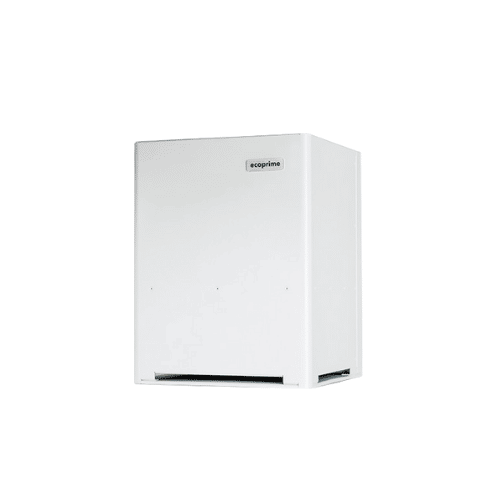
EcoPrime is small and lightweight, making it easy to move around. What’s more, its low operating noise means it can be installed in any room, such as conference rooms, waiting rooms, offices, etc…
The EcoPrime air purifier has a filtration capacity of up to 190 cubic meters per hour, making it highly suitable for areas of up to 60 square meters. It features a V-protect main filter, capable of treating viruses and bacteria down to 0.07 microns in size with over 99.53% efficiency (ISO 29463 certification).
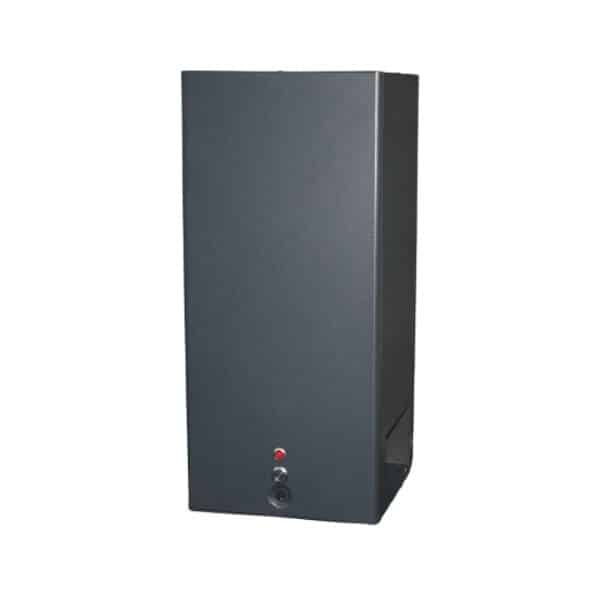
EPUR05 is an air purifier equipped with a high-precision filter capable of treating viruses and bacteria as well as fine dust, CMR and aerosols. This purifier has an adjustable flow rate and is ideal for surfaces up to 100 square meters.
It is designed for low operating noise, only 47 dB at maximum operation.
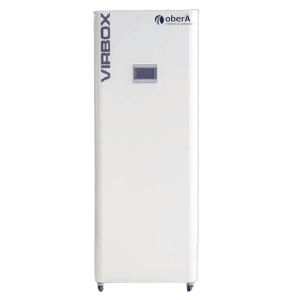
Virbox is an anti-virus air purifier designed specifically to treat viruses and bacteria. Virbox can filter 99.995% of viruses and bacteria from ambient air. Its design makes it easy to move and easy to get through the door. With VirBox air purifiers, aerosols can be captured and filtered as close as possible to their point of discharge. This is thanks to perforations installed on the top of the device, which allow aerosols to be inhaled at a height where people reject them. Multifunctional, VirBox can also be used as a communication medium.
What type of purifier to choose and what treatment?
The French National Institute for Research and Safety (INRS) warns against certain physico-chemical treatment processes (photocatalysis, ozonation, UV, etc.), which not only fail to reduce the risk of virus transmission, but can also generate new risks.
In particular, processes that generate UV and ozone because :
- Solids and gases in the room can decompose under the action of UV light into by-products that can be harmful to health (VOCs, chlorinated compounds in particular).
- UV lamps produce ozone. UV equipment generates ozone concentrations up to 100 times higher than the daily VLEP(VLEP = Occupational Exposure Limit). Ozone, absorbed by the mucous membranes of the respiratory tract (nose, trachea, bronchi, alveoli), reacts locally to damage cell membranes. Chronic exposure causes emphysema and pulmonary fibrosis. Ozone induces gene mutations in various cell types and strains.
- UV lamps generally use mercury vapor to generate germicidal UV-C radiation. If the lamp is destroyed, the mercury is released (Hg is a substance classified as CMR-Carcinogenic, Mutagenic, Reprotoxic). Replacement must therefore be carried out by trained and authorized personnel. The waste is disposed of as hazardous waste, with a waste tracking slip.
- For personnel exposed to UV-C radiation (when replacing lamps, for example, or in the event of improper use of the equipment), the health risks can be considerable: to the skin, with “sunburn” ranging from simple erythema to more serious lesions to the eyes.
INRS concludes that, in view of the risks incurred by the use of ozone gas and the uncertainties that seem to exist as to its effectiveness against SARS-CoV-2, the application of the chemical risk prevention approach makes it necessary to seek to substitute this process with another less hazardous one, and recommends mechanical filtration solutions with HEPA H13 filtration as a minimum.
How to install an air purifier in the classroom?
Ideally, the classroom air purifier should be positioned at the front of the table or in the center of the back of the room. In the case of a room where the tables are positioned in a U-shape, the air purifier can also be positioned in the center of the room. The ceiling should be as smooth as possible in the area where the air purifier is located. The flow rate of the air purifier should be at least 5 times the volume of the space. During pauses, the flow rate should be set to maximum power (if the unit is equipped with an adjustable flow rate). It is also advisable to reduce the concentration of CO2 in the room. If possible, we recommend opening or tilting a window during breaks, at least 3 times a day. This will not affect the air purifier’s filtration performance.
How do you install an air purifier in a dining hall?
High-performance air purifiers are needed to reduce the indirect risk of infection. Depending on the situation and the size of the room, it is recommended to use several devices to ensure at least 6 times the ambient air circulation per hour throughout the catering area with high-efficiency HEPA air purification. People working in the food distribution area should also be protected by partitions with an aerosol protection rim.
Air purifiers notwithstanding: you still need to ventilate!
Some establishments have chosen to install CO2 sensors to continuously measure CO2 concentration and warn when the room needs to be ventilated, once the threshold has been exceeded. In addition to air purification, we recommend opening classroom windows when CO2 levels reach 1000 ppm or more. The use of room air purifiers does not make this compulsory, but we do recommend it to avoid excessive levels of CO2 in the ambient air, thus reducing aerosol concentrations.
CO2 sensors tell you when to ventilate
Several teachers’ unions are calling for the installation of CO2 sensors to monitor air quality on an ongoing basis. These CO2 sensors are a good tool for making air quality in classrooms visible: “In classrooms, C02 sensors show when limits have been reached and when windows should be opened.”
Many studies recommend the use of CO2 sensors indoors. In this respect, it would be a good idea to apply them to all classrooms in particular. These measuring instruments sound the alarm when interiors need to be ventilated.
School and community support programs
Several French regions have decided to finance all or part of the purchase of air purifiers to help educational establishments equip themselves.
The Auvergne-Rhône-Alpes region has voted a 10 million euro regional investment plan for air purification in its high schools and schools. The Ile de France region, meanwhile, is providing 10,000 EUR in funding for high schools and local authorities to purchase sanitary equipment such as air purifiers like our ePUR and VirBox.
