Sommaire
Anti-bacterial aeration solutions in education
Learning together is essential for children and teenagers. And best of all, it’s still possible in the classroom, as long as the air is clean and sanitary conditions are respected.
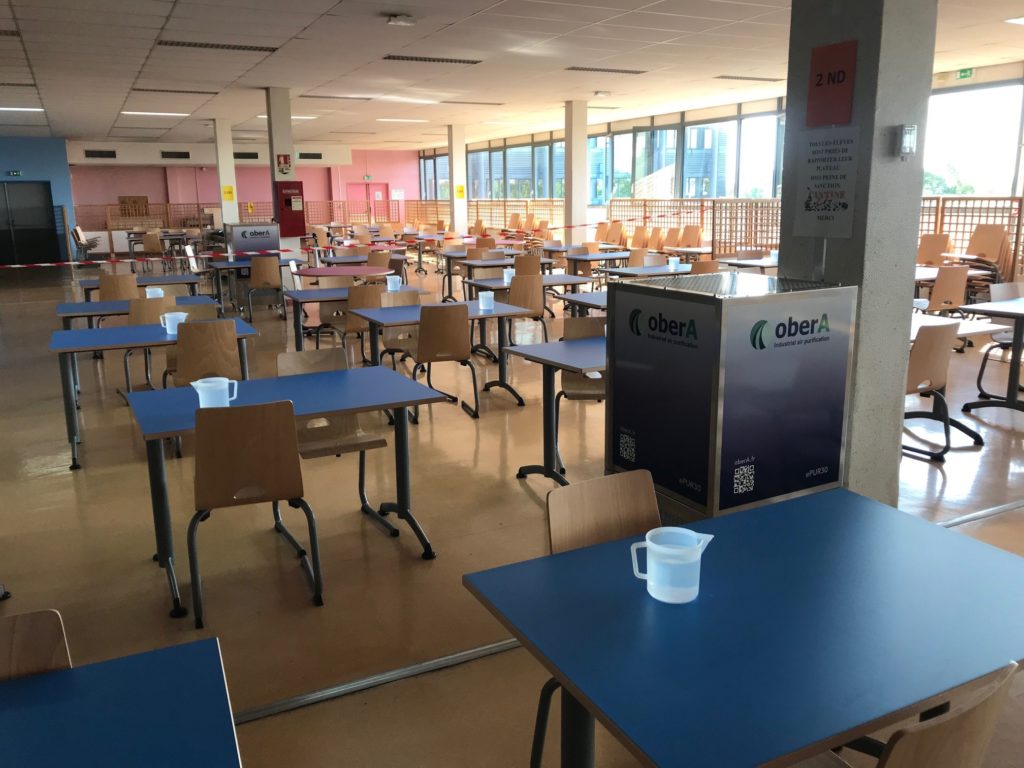
Several French regions have decided to finance all or part of the purchase of air purifiers to help educational establishments equip themselves:
- The Auvergne-Rhône-Alpes region has voted in a 10 million euro regional investment plan for air purification in the region’s high schools and colleges.
- The Ile de France region provides funding of up to EUR 10,000 for high schools and local authorities to purchase sanitary equipment such as air purifiers.
With the return of face-to-face classes and the use of canteens and refectories, air purifiers are needed to treat areas with high concentrations of people and/or areas with large numbers of students at the same time. Air purification units treat the air in the zones with the equivalent of about four to ten room volume changes per hour.
This significantly reduces the number of airborne particles and viruses (-85% on average) and significantly purifies the air in the room.
To reduce the risk of contagion indoors, however, regular ventilation is essential. However, this is not always possible (when rooms have no windows or when it’s too cold). In this case, installing an air purifier andsensors for continuous measurement of air quality parameters may be the solution.
Air purifiers notwithstanding: you still need to ventilate!
Some establishments have also chosen to install CO2 sensors to continuously measure CO2 concentration and trigger ventilation if the recommended threshold is exceeded.
A fun tool: blue LED: all is well; red LED: you need to ventilate
Several teachers’ unions are calling for the installation of CO2 sensors to continuously monitor air quality.
Many studies recommend the use of CO2 sensors indoors. In this respect, it would be a good idea to apply them to all classrooms in particular. These measuring instruments sound the alarm when interiors need to be ventilated. These sensors are a good tool for making air quality in classrooms visible:
“In the rooms, they show when the limits have been reached and the windows need to be opened.”
