Sommaire
What you need to know about coolants
Many machine tools used for machining or processing processes use cooling fluids. As the resulting vapors and mists must not exceed a value set by the legislator (occupational health and safety), here we answer your questions on the subject of oil mist extraction. and emulsion.
What are cutting fluid mists and what are they used for?
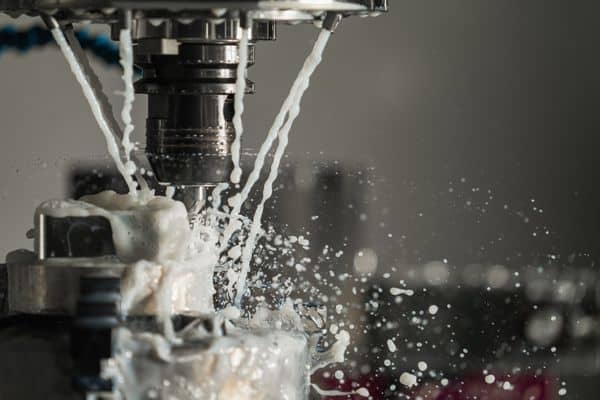
When milling, turning, drilling, etc., full-fat oils or emulsions (oil + water) are used for cooling and lubrication, to minimize tool and workpiece heating generated during machining. This has a number of advantages: reduced friction forces improve material surface quality and extend machining tool life. What’s more, the emulsion binds the dust that forms and removes it from the workpiece along with the swarf.
What are the risks associated with cooling lubricants?
However, the use of cutting fluids has one major drawback. Due to high tool speeds, cutting fluid injection pressures and high temperatures, the coolant mixture is distributed in fine particles in the air. These particles have been shown to be to some extent hazardous to health, and can contribute to occupational illness. So it’s vital to vacuum them up accordingly. What’s more, the higher the fluid pressures and tool rotation speeds, the finer the particles emitted.
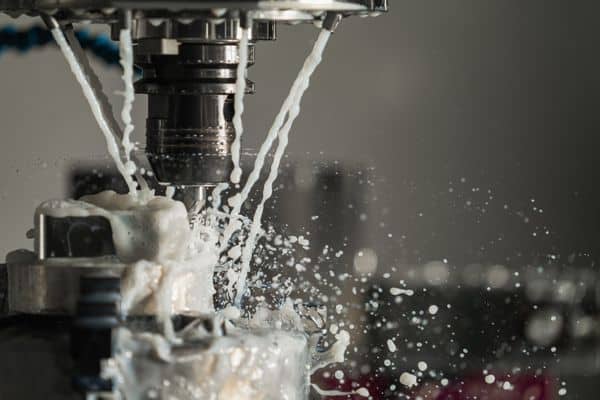
Emissions from cutting fluids

In France, there are strictly speaking no occupational exposure limit values for aerosols of oils or cutting fluids (whole oils or aqueous fluids). However, in the air inhaled by operators, it is recommended not to exceed a concentration of 0.5 mg/m3 on average, over the duration of an 8-hour work shift (see Cnam recommendation R 451).
If hazardous substances are generated either in the cutting oils used or in machined metals (e.g. alloys based on Nickel, Cobalt, Titanium, etc.), it is necessary to comply with the occupational exposure limit values for these compounds specifically.
Coolants in the workplace
When working with cooling lubricants, the company must ensure that the following risks are eliminated or reduced to a minimum, insofar as the state of the art allows: risks associated with skin and eye contact, absorption by the body,emission into the air, and fire and explosion hazards.
If basic measures are not sufficient, airflow measures such as extraction systems and filter separators or airflow systems are required.
Which suction and filtration system for which type of aerosol?
The suitability of separators (aerosol separators, oil mist separators, emulsion mist separators) for cutting fluid emissions is shown in the table below.
| Huile | Emulsion | Micro lubrification | Fumée | Vapeur | |
|---|---|---|---|---|---|
| Filtre électrostatique | A | C/A* | C | A | D |
| Filtres mécanique (Oilmac et AFS OberA) | C/B* | A | A | A | D |
| Dépoussiéreur | D | D | A | C | D |
| Séparateur centrifuge | C | C | D | D | D |
A = Suitable B= Conditionally suitable C = Unsuitable D = Unsuitable *in central installations
Separation systems are not protected against fire and explosion.
In addition, the separated substances may only be reintroduced into the cooling lubricant circuit if this reintroduction does not result in any additional hazard, for example due to a change in composition or microbial colonization of the separated substances.
For substances that are carcinogenic, mutagenic or toxic to health and reproduction (CMR), the air must not be recycled/reintroduced into the workroom.
OILMAC and AFS OberA oil mist and emulsion separators
Oil mist separator for extraction of aerosols and mist particles.
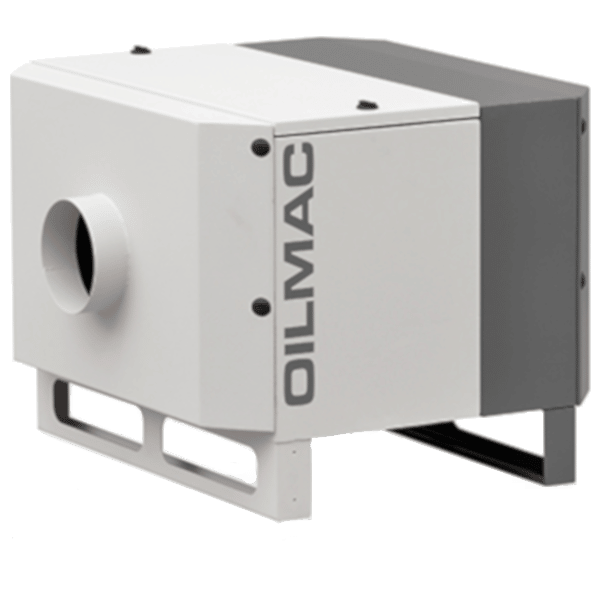
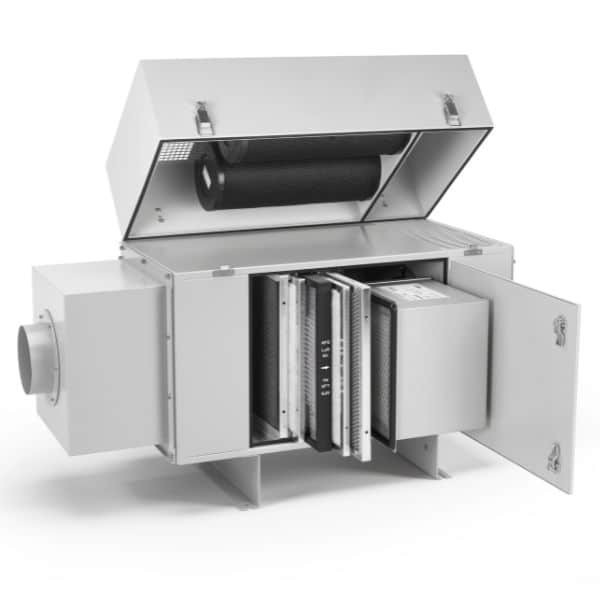
As a rule, OILMAC and AFS units are installed directly on the machine enclosure and connected via a flexible hose. The three-stage filtration system ensures efficient filtration of cooling lubricant mist or smoke that forms during the machining process. The filtered cutting fluids can then be fed back into the machine. Thanks to a HEPA H13 filter, the air can be reintroduced into the work area while complying with the relevant limit values.
